![[등록] 2026-09-01 15:48:31](/support/_updata/banner2/tl181982910_6749.png)


(C) The Japan Times
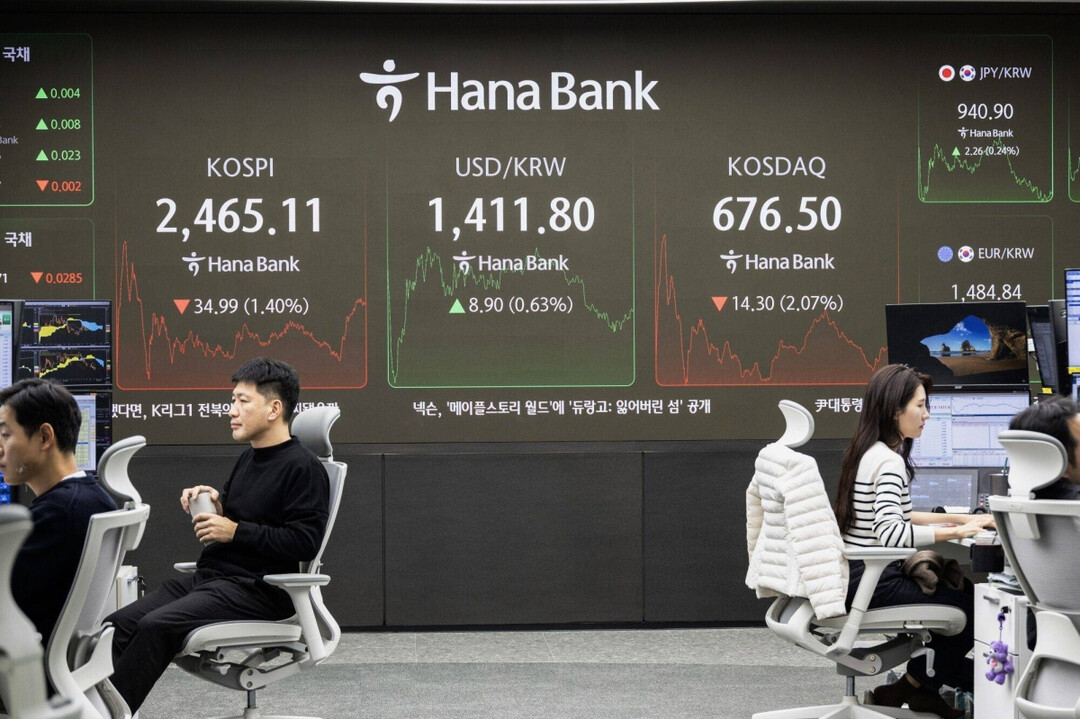
The South Korean financial market is showing clear signs of distress as the KOSPI index, the Korean Won, and government bond (Kukgochae) prices all experience a simultaneous decline. The situation has prompted serious concern regarding the stability of the domestic market.
On November 7, 2025, the KOSPI closed at 3,953.76, down 1.81% (72.69 points) from the previous trading day. This marked the first time the index finished below the crucial 4,000-point level since October 24. Although the KOSPI briefly turned positive in the morning thanks to foreign net buying, the index rapidly reversed course and sharply declined after foreign investors shifted to net selling around 11 a.m. KST, at one point plunging by 3.46% to 3,887.32.
Foreign Investor Exodus and Currency Weakness
Foreign investors were net sellers of 479.1 billion KRW on the main KOSPI market on November 7. They have now been net sellers for every trading day this month, totaling approximately 7.3 trillion KRW in net sales. Conversely, retail investors have acted as a crucial buffer, having been net buyers throughout the month, purchasing 695.9 billion KRW worth of stocks on the day alone, amounting to around 7.46 trillion KRW in net purchases for the month.
The Korean Won-US Dollar exchange rate closed the week at 1,456.9 KRW per dollar, an increase of 9.2 KRW from the previous day. This represents the highest weekly closing rate since April 9, when concerns over "reciprocal tariffs" were at their peak (1,484.1 KRW). This depreciation of the Won, a so-called "risk currency," is a direct result of heightened global financial market uncertainty.
The market is caught in a vicious cycle of currency depreciation and stock decline. As the Won weakens, foreign capital is drawn away from the domestic stock market. This foreign investor exodus, in turn, accelerates the Won's decline, further pushing down stock prices. The breaking of the 1,450 KRW threshold for the exchange rate was a major factor contributing to the day's significant foreign capital flight.
Bond Market Slump and Economic Headwinds
The bond market is also in a slump. The yield on the 3-year government bond rose by 0.060 percentage points to 2.894%, and the yield on the 10-year government bond rose by 0.023 percentage points to 3.226%. Higher yields mean lower bond prices. These yields are the highest recorded in a year (since November 18 and July 11 of the previous year, respectively), despite the Bank of Korea having cut the base rate twice this year. The rise in bond yields signals a drop in bond prices.
A bond fund manager noted that the domestic bond market's weakness persists despite the recent strength in U.S. Treasury bonds, citing consecutive days of rising domestic government bond yields and growing concerns over the credit market.
The outlook for the Won remains weak. Experts suggest the Won's depreciation is likely to be prolonged due to the recent strengthening of the US Dollar and a lack of clear factors that would lead to a sustained decline in the exchange rate. The Won's long-term weakness is also being tied to the potential for domestic capital to flow to the US and unresolved issues with domestic demand, suggesting that currency weakness may persist regardless of the stock market's performance. The weakening of the bond market also increases the funding costs for corporations, placing further downward pressure on the overall economy.
Despite the current downturn, some analysts maintain that the stock market is undergoing a necessary "correction phase." They view the current turbulence as a process of "digesting bad news," suggesting that the short-term adjustment may simply be a "comma" in a broader upward trend.
[Copyright (c) Global Economic Times. All Rights Reserved.]