![[등록] 2026-09-01 15:48:31](/support/_updata/banner2/tl181982910_6749.png)


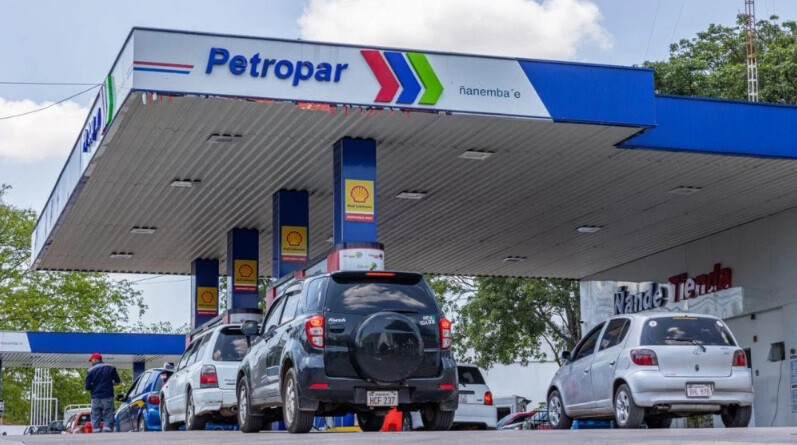
Asunción, Paraguay - Paraguayan fuel distributors have voiced concerns that the government's recent announcement of a reduction in fuel prices may only be a temporary measure. On Monday, President Santiago Peña declared that the state-owned oil company Petropar would decrease the price of all fuels, including gasoline and diesel, by 270 guaraníes (approximately ₩37 KRW) per liter, a move intended to bring welcome news to citizens ahead of the country's Independence Day.
However, the Paraguayan Association of Fuel Distributors (CADIPAC) has expressed apprehension that the volatility of international oil prices could soon reverse this price cut. Miguel Bazán, the president of CADIPAC, stated in a radio interview, "Making a decision like Petropar's at a time when international oil prices are very unstable is risky. We believe this is more of a political decision than a technical one."
Bazán highlighted that the price reduction announcement coincided with the beginning of another upward trend in international oil prices, further fueling his concerns. "If we follow the trend of international prices, we may have to readjust the price by the 270 guaraníes that were reduced, or even more," he cautioned. He noted that just last week, diesel prices were in the range of $202 to $205 per barrel, but have recently climbed to $213.
Predicting that the government's announced fuel prices would not last long, Bazán asserted, "If this upward trend in oil prices continues, we will have to adjust prices again within 30 days."
Previously, President Santiago Peña had announced the price reduction on his social media, stating, "Paraguay and you do not stop. We are reducing the price of all Petropar fuels by 270 guaraníes," framing it as a significant achievement to celebrate in the lead-up to Independence Day.
The new prices took effect on Monday. "Nafta Ka’ê 88," the 88-octane gasoline, is now selling at 5,860 guaraníes per liter, "Oikoite 93" (93 octane) at 6,360 guaraníes, and the premium gasoline "Aratiri 97" at 7,710 guaraníes. Diesel prices have also been reduced, with regular diesel "Diésel Porã" now at 6,920 guaraníes per liter and premium diesel "Imbarete" at 8,720 guaraníes.
Increased International Oil Price Volatility: Impact on Paraguay's Economy?
International oil prices have been experiencing heightened volatility recently due to geopolitical instability and production cuts by major oil-producing nations. The prolonged Russia-Ukraine war and escalating tensions in the Middle East are particularly contributing to upward pressure on oil prices. This situation directly impacts economies like Paraguay, which heavily relies on oil imports.
Paraguay has minimal domestic oil production capacity and depends on imports for most of its petroleum products. Consequently, increases in international oil prices translate directly into higher domestic fuel prices, increasing the burden on consumers and potentially triggering broader inflation. Notably, rising transportation and logistics costs can lead to price hikes in various goods, including agricultural and manufactured products, significantly affecting the livelihoods of ordinary citizens.
The government's fuel price reduction is seen as an attempt to temporarily alleviate this burden on the population. The timing of the announcement, ahead of Independence Day, also suggests a political motivation to convey a positive message and highlight the government's efforts to stabilize the economy. However, as CADIPAC warns, if the upward trend in international oil prices persists, the government's measure is likely to have only a short-term effect.
Divergent Views Between Government and Distributors: The Way Forward?
The government and fuel distributors hold somewhat different perspectives regarding fuel price policies. The government prioritizes price stability and aims to minimize the burden on citizens, while distributors are concerned about potential losses due to fluctuations in international oil prices and advocate for price adjustments that reflect market realities.
To bridge this gap and establish a sustainable fuel price policy, close communication and cooperation between the government and fuel distributors are essential. Transparent information sharing is crucial for accurately predicting international oil price trends and developing a rational price adjustment mechanism accordingly. Furthermore, there are calls for long-term policy efforts to reduce dependence on oil imports and enhance energy self-sufficiency.
Some suggest that the government should consider additional policy measures, such as reducing fuel taxes. However, fuel tax cuts could strain government finances, necessitating careful consideration. Expanding targeted support policies for vulnerable populations to help with fuel costs could also be explored to ensure social equity.
In conclusion, while the Paraguayan government's fuel price reduction may offer temporary relief to the public, it is vulnerable to external factors like international oil price volatility. Rather than focusing solely on short-term price adjustments, the government and fuel distributors must work together to build a stable energy supply system in the long term and develop sustainable policies that minimize the burden on citizens.
[Copyright (c) Global Economic Times. All Rights Reserved.]