![[등록] 2026-09-01 15:48:31](/support/_updata/banner2/tl181982910_6749.png)


(C) Al Jazeera
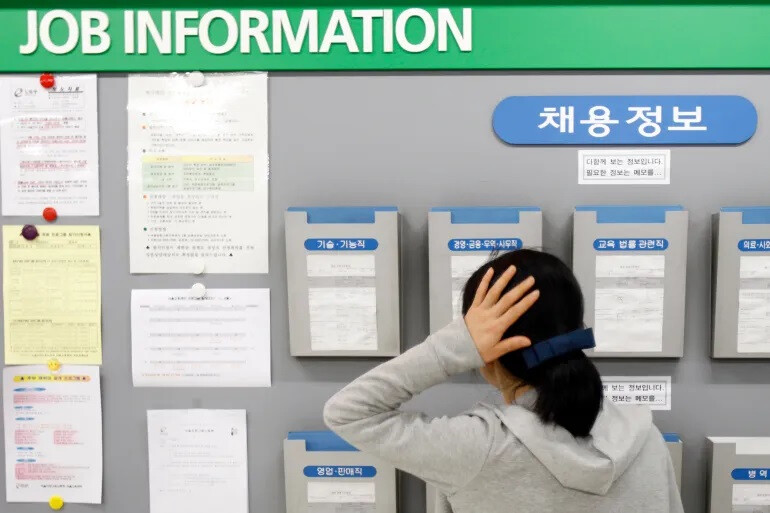
Despite a significant slowdown in economic growth, South Korea continues to report surprisingly low unemployment rates. This counterintuitive trend, where falling economic growth coincides with a low jobless rate, suggests a statistical illusion rather than a robust labor market. Analysis reveals that the falling unemployment rate is largely due to an increasing number of young adults opting out of the labor market entirely, becoming an "economically inactive population" that is not counted as unemployed.
South Korea's economic growth momentum has slowed dramatically. The country's real Gross Domestic Product (GDP) growth rate nearly halved, dropping from $4.6%$ in 2021 to a projected $2.0%$ in 2024. Current forecasts suggest that an annual growth rate even slightly above $1%$ would be considered a favorable outcome. This subdued economic outlook, compounded by historic lows in the construction sector, points to worsening overall business and employment conditions.
However, data from the National Data Office (formerly Statistics Korea) indicates that the unemployment rate remains at a persistently low level. For example, the unemployment rate in September of a recent year was reported at just $2.1%$, a stark contrast to the $4.0%$ rate seen during the height of the COVID-19 pandemic in 2020. This apparent disconnect between poor economic performance and favorable unemployment numbers raises a critical question about the true state of the labor market.
The paradox is explained by the technical definition of unemployment used in labor statistics. An individual is only classified as unemployed if they are willing and able to work and have actively sought a job within the last four weeks.
Those who have stopped looking for work—effectively giving up their job search—are not counted as unemployed. Instead, they are categorized as part of the economically inactive population, which includes students, homemakers, retirees, and a growing segment referred to as the "resting population" ($'쉬었음' 인구$). By definition, these individuals are excluded from the labor force denominator (economically active population = employed + unemployed), thus lowering the official unemployment rate without any actual improvement in job availability.
The primary driver of this statistical anomaly is the sharp rise in young adults, particularly those in their 20s, who are joining the 'resting' demographic. The proportion of the total 20-something population categorized as 'resting' has risen significantly, from $4.4%$ in 2015 to $7.2%$ as of the first three quarters of 2025. This means that approximately seven out of every 100 young adults in this key demographic are intentionally or unintentionally out of the workforce.
This trend is a critical indicator of structural issues within the labor market. Young people, facing fierce competition and an apparent lack of high-quality, regular job opportunities, are growing disillusioned and choosing to exit the job hunt altogether.
Experts, including those from the Korea Development Institute (KDI), warn that a low unemployment rate does not signal improved employment conditions but rather the structural detachment of the youth population from the labor market. The KDI estimates that without this shift, the official unemployment rate would have been about $0.6$ percentage points higher than current figures.
The core concern is that a long-term erosion of job-seeking motivation among the youth could permanently shrink the nation's human resource pool, exacerbating the challenges of a rapidly aging and shrinking population. KDI strongly advocates for the meticulous design of support systems to facilitate the entry of young people into the labor market and, specifically, to re-engage those in the long-term 'resting' category. Addressing the declining economic prospects that push young talent out of the workforce is essential for securing South Korea's long-term economic vitality.
[Copyright (c) Global Economic Times. All Rights Reserved.]