• 2026.03.22 (Sun)
  • All articles
  • LOGIN
  • JOIN
Global Economic Times
fashionrunwayshow2026
  • Synthesis
  • World
  • Business
  • Industry
  • ICT
  • Distribution Economy
  • Well+Being
  • Travel
  • Eco-News
  • Education
  • Korean Wave News
  • Opinion
  • Arts&Culture
  • Sports
  • People & Life
    • International Student Report
    • With Ambassador
  • Column
    • Cho Kijo Column
    • Cherry Garden Story
    • Ko Yong-chul Column
    • Kim Seul-Ong Column
    • Lee Yeon-sil Column
  • Photo News
  • New Book Guide
MENU
 
Home > World

Madrid Barajas International Airport Grapples with Homelessness: Earns "Zombieland" Moniker

Pedro Espinola Special Correspondent / Updated : 2025-06-02 09:45:46
  • -
  • +
  • Print

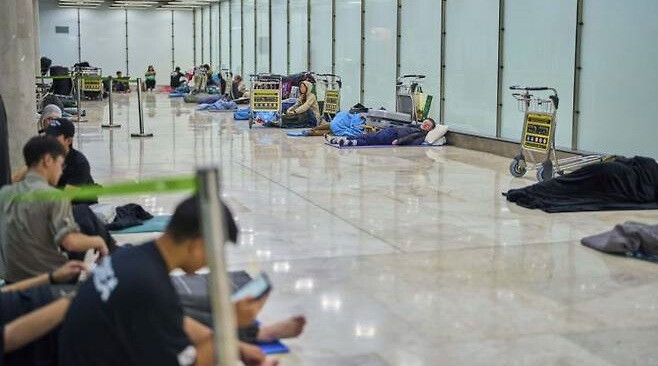
Madrid Barajas International Airport, Spain's gateway and largest airport, is suffering from a severe homelessness problem. Unable to afford skyrocketing housing rents, many have made the airport their temporary home, leading to some terminals earning the ignominious title of "Zombieland." Currently, up to 500 homeless individuals are estimated to be living within the airport terminals.

The majority of these individuals are known to work day labor jobs during the day and then, often intoxicated, sleep on the airport floor at night. There have even been instances of people urinating where they sleep, causing a pervasive foul odor and puddles of urine in various parts of the airport hallways, severely deteriorating hygiene. This environmental degradation has led to an outbreak of pests such as bedbugs, mites, and cockroaches. Even airport staff have reported being bitten by these pests, raising serious concerns about working conditions. Ultimately, airport authorities have had to mobilize professional pest control companies for extensive disinfection operations.

Furthermore, there are claims of drug use, prostitution, and even weapon possession within the homeless community. Police have intervened or arrested some homeless individuals found with axes or knives, and they conduct regular patrols to verify identities and apprehend wanted persons. Despite continuous patrols by airport authorities, minor disputes frequently escalate into violence, indicating a serious security issue.

The fundamental cause of this situation is Spain's rapid increase in housing rental prices. According to the real estate information site Idealista, the average rental price across Spain has nearly doubled over the past decade, and in the capital, Madrid, it has effectively risen by about 60% during the same period. This signifies a significant increase in housing cost burden in both the housing purchase and rental markets. Moreover, Spain has a markedly insufficient public housing stock compared to other European Union (EU) countries. As of 2023, Spain's social housing ratio was 2.5%, significantly lower than the European average of 9.3%, and new housing supply also falls short of market demand. The shortage of public housing supply, coupled with many homes being diverted for tourism, is further reducing available housing for residents.

As those without stable homes flocked to the 24-hour airport to avoid living on the streets, AENA, the Spanish airport operator, announced stricter entry regulations for Madrid Airport on May 14th. The main content of the new rules is that all visitors must present their boarding passes upon entry, and specifically, after 9 PM, only ticket holders, airport staff, and their companions will be permitted to enter. These measures are interpreted as an effort to clarify that the airport is a space for transit, not residence, and to address the security and hygiene issues caused by the homeless problem. However, airport authorities have stated that solving the homelessness issue cannot be achieved by mere entry restrictions and that active support from Madrid City Council is necessary.

The homelessness problem at Madrid Barajas International Airport is not merely an airport issue; it is a clear reflection of Spain's broader housing crisis and the structural problem of insufficient support for vulnerable social groups. Economic hardships exacerbated after the pandemic and the lack of affordable housing have forced many onto the streets, and public spaces like airports have become unintended shelters for them. This situation suggests that it is time for Spanish society to seek more fundamental solutions for guaranteeing housing rights and protecting vulnerable populations.

[Copyright (c) Global Economic Times. All Rights Reserved.]

  • #NATO
  • #OTAN
  • #OECD
  • #G20
  • #globaleconomictimes
  • #Korea
  • #UNPEACEKOR
  • #micorea
  • #mykorea
  • #UN
  • #UNESCO
  • #nammidonganews
  • #sin
Pedro Espinola Special Correspondent

Popular articles

  • A New Era in The Hague: Rob Jetten Sworn In as Netherlands’ Youngest and First Openly Gay Prime Minister

  • Mexico on Edge: ‘King of Cocaine’ El Mencho Killed, Igniting Wave of Cartel Retaliation

  • The "Chicken-Sized" Dino: 900g Fossil Overturns Evolution Theory

I like it
Share
  • Facebook
  • X
  • Kakaotalk
  • LINE
  • BAND
  • NAVER
  • https://www.globaleconomictimes.kr/article/1065573883833657 Copy URL copied.
Comments >

Comments 0

Weekly Hot Issue

  • Coway Clinches Top Honor at "Water Taste Awards" for 7th Consecutive Year
  • HP Targets Korea as Strategic Hub for 'Edge AI' Expansion, Seeking Startup Partnerships
  • Pearl Abyss’s 'Crimson Desert' Shatters Records with 2 Million Copies Sold on Day One
  • "BTS Over Books?" Indian Academies Issue Emergency Notices as Students Plot Mass Absences for Comeback Live
  • Naver to Shut Down Men's Fashion Service 'MR.' to Launch Expanded AI-Driven Fashion Platform
  • JBNU and SKKU Researchers Achieve Breakthrough in "Dream Material" MXene, Setting New World Records in Performance

Most Viewed

1
An Open Letter to BTS On the Eve of a Historic Performance
2
From Industrial Capital to Tourism Mecca... Ulsan Makes a Bold Move with ‘Experiential Content’ in 2026
3
Ko Sang-goo, President of World Federation of Korean Associations, Elected as First Private Sector Chair of World Korean Community Leaders Convention
4
It is Time for BTS’s Fandom, ARMY, to Step Forward
5
Korean Stock Market Plunges: Circuit Breaker and Sidecar Triggered Amid Geopolitical Crisis
광고문의
임시1
임시3
임시2

Hot Issue

Vishay Unveils Ultra-Compact 0404 RGB LED with Independent Chip Control for Enhanced Color Precision

Coway Clinches Top Honor at "Water Taste Awards" for 7th Consecutive Year

AI Medical Ecosystem in Focus: KIMES 2026 Opens in Seoul as Global Healthcare Hub

Netanyahu Declares Decisive Blow to Iran’s Nuclear and Missile Programs, Signals Early End to War

Let’s recycle the old blankets in Jeju Island’s closet instead of incinerating them.

Global Economic Times
korocamia@naver.com
CEO : LEE YEON-SIL
Publisher : KO YONG-CHUL
Registration number : Seoul, A55681
Registration Date : 2024-10-24
Youth Protection Manager: KO YONG-CHUL
Singapore Headquarters
5A Woodlands Road #11-34 The Tennery. S'677728
Korean Branch
Phone : +82(0)10 4724 5264
#304, 6 Nonhyeon-ro 111-gil, Gangnam-gu, Seoul
Copyright © Global Economic Times All Rights Reserved
  • 에이펙2025
  • APEC2025가이드북TV
  • 독도는우리땅
Search
Category
  • All articles
  • Synthesis
  • World
  • Business
  • Industry
  • ICT
  • Distribution Economy
  • Well+Being
  • Travel
  • Eco-News
  • Education
  • Korean Wave News
  • Opinion
  • Arts&Culture
  • Sports
  • People & Life 
    • 전체
    • International Student Report
    • With Ambassador
  • Column 
    • 전체
    • Cho Kijo Column
    • Cherry Garden Story
    • Ko Yong-chul Column
    • Kim Seul-Ong Column
    • Lee Yeon-sil Column
  • Photo News
  • New Book Guide
  • Multicultural News
  • Jobs & Workers