GONGJU — South Korea’s heritage authorities and local governing bodies have unveiled groundbreaking archaeological findings at Gongsanseong Fortress, shedding new light on the architectural layout and political ambitions of the ancient Baekje Kingdom (18 BCE – 660 CE).
The joint announcement, hosted by the Korea Heritage Service alongside Chungcheongnam-do Province, the City of Gongju, and Kongju National University, marked a major milestone in understanding the spatial organization of Baekje’s royal capital during the Ungjin period (475–538 CE).
A Royal Landscape Comes to Light
Perched above the Geumgang River, Gongsanseong Fortress has long been recognized as a pivotal royal stronghold. While limited excavations began in the 1980s, systematic academic investigations accelerated following the fortress's designation as a UNESCO World Heritage site in 2015.
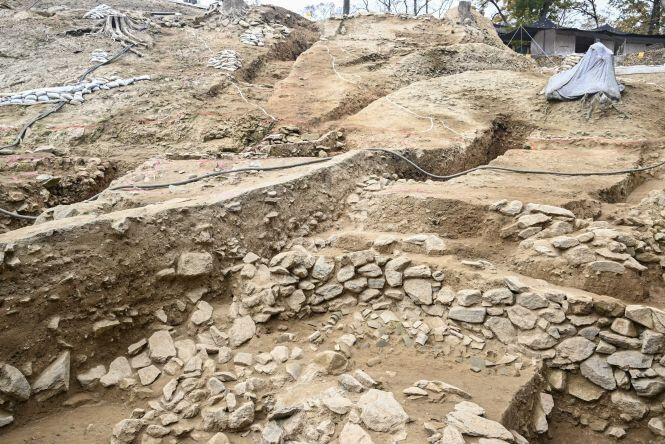
Recent digs around the historic Ssangsujeong pavilion zone have unearthed core elements of a royal compound. These include extensive corridor-style hall foundations, large-scale building footprints, defensive walls, and ancient pond features. Most notably, researchers highlighted a grand palace gate architecture known as mungwol—the first discovered archaeological evidence of its kind in South Korea.
Architecture of Authority
The newly detailed mungwol complex features a 10-meter-wide central avenue flanked by massive, symmetrical gate towers measuring up to 40 meters across and rising over 9 meters in height. According to archaeologists, this monumental gateway was designed to project absolute royal authority and stabilize the monarchy following Baekje’s emergency relocation of its capital to Ungjin (modern-day Gongju) after the fall of Hanseong in 475 CE.
Experts emphasize that this architectural grandeur aligns with historical records of gaengwigang-guk—King Muryeong’s famous 521 CE declaration to China’s Liang Dynasty, proclaiming Baekje’s successful national revival and restored geopolitical standing.
Further structural analyses revealed a massive engineered platform created by filling a 3-to-7-meter deep valley, covering an area of over 100 by 80 meters, complemented by tiered earthen terraces (todan). These large building footprints share striking structural similarities with contemporaneous royal sites in Buyeo (Gwanbuk-ri) and Iksan (Wanggung-ri), demonstrating a cohesive Baekje royal architectural tradition.
Reconstructing Ancient Craftsmanship
In tandem with the architectural revelations, the presentation showcased meticulously reconstructed pieces of lacquered leather armor (chilchil-gapot) and armored horse regalia (magap). Following years of intensive conservation and material analysis, researchers successfully decoded the sophisticated ancient military technology utilized by Baekje elite forces.
Collaborative Future
Officials stressed that the breakthrough is a triumph of multi-tiered public cooperation, bridging national oversight, provincial administration, municipal support, and regional academic expertise.
The Korea Heritage Service announced plans to maintain these collaborative regional networks, aiming to further uncover the hidden dimensions of Baekje’s royal capitals and continuously enhance the global educational and cultural value of Gongsanseong Fortress.
[Copyright (c) Global Economic Times. All Rights Reserved.]