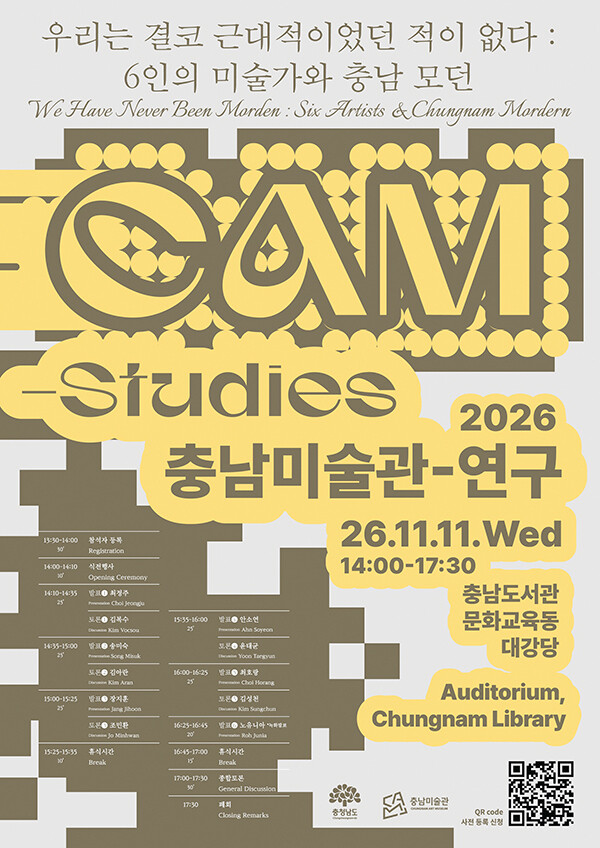
On the 11th, Chungcheongnam-do successfully hosted the "2026 Chungnam Art Museum Research (CAM-Studies)" presentation titled “We Have Never Been Modern: Six Artists and Chungnam Modernism” at the main auditorium of the Chungnam Library Cultural Education Building.
Having previously operated as a "research group" program, Chungnam Art Museum revamped the initiative and revealed its first findings at this presentation. Six researchers have been studying six Chungnam artists across the fields of painting, sculpture, calligraphy, and crafts/design since last July. Through their presentations, they shed new light on these artists' artistic legacies and broadened the interpretive possibilities for both Chungnam art and modern and contemporary Korean art.
In the first presentation, researcher Choi Jung-ju examined Lee Ma-dong’s Man (1931). Analyzing the image of an "unnamed modern person" who possessed a modern exterior in the 1930s yet could not be pinned down to a specific identity or class, Choi proposed the concept of a "social portrait." Discussant Kim Bok-soo noted that this research expanded the question of “Whose portrait is this?” into “How does modern society perceive and categorize individuals through visual markers?” He added that it offered new interpretive possibilities for research on modern Korean portraiture.
Researcher Song Mi-sook restored Cho Jung-hyun's (Simwon) stay in Chungnam during the 1950s, a period previously mentioned only as a brief passage in his biography. She newly highlighted his regional art education activities, where he taught students while working as an art teacher in Hongseong and Daejeon. Discussant Kim A-ran evaluated that despite incomplete records, the research concretely uncovered Cho’s activities in Chungnam. She further expressed hope that these research findings would be reflected in the Chungnam Art Museum’s artwork acquisition and archive construction.
Next, researcher Jang Ji-hoon analyzed Won-gok Kim Gi-seung’s Wongok-che style and ink-shadow (mukyeong) works. He evaluated them as "Korean modernist calligraphy" that realized independent modernity based on Hangeul and East Asian brush-and-ink traditions rather than merely following Western styles. Discussant Cho Min-hwan highly praised the study for providing an important starting point to newly recognize the identity and modernity of contemporary Korean calligraphy.
Researcher An So-yeon re-examined the sculptures of Yoon Young-ja—traditionally interpreted largely around themes of motherhood and love—from formal and stylistic perspectives. She focused on Yoon's sculptural experiments, which started from human body forms and expanded to abstract and monumental public sculptures. Discussant Yoon Tae-gyun evaluated that analyzing works such as her 1974 Torso revealed previously overlooked aspects of Yoon’s sculpture, and suggested expanding the discussion to the formal experiments of first-generation female sculptors.
Researcher Choi Ho-rang focused on the perspective grids appearing in the background of Kim Kyo-man’s illustrations in the 1980s. He analyzed an independent screen composition style that placed traditional and Korean subjects within modern and futuristic spaces. Discussant Kim Seong-cheon noted that the study newly interpreted Kim Kyo-man’s work by focusing on grids and spatial expression, moving away from conventional subject-centered interpretations of Korean lyricism and humor.
Finally, via video presentation, researcher Noh Yu-nia shed light on Lim Sook-ja, a native of Cheonan. Lim graduated from the Department of Design at the Tokyo School of Fine Arts, returned to Korea, introduced modern design concepts and methods to craft based on artisan traditions, and practiced it professionally. Noh evaluated her as a figure who could be called South Korea’s first designer.
In the ensuing general discussion, participants examined the diverse ways in which the modernity of Korean art was formed and developed through the different modern practices demonstrated by the six artists, while also discussing new directions and tasks for Chungnam modern art history research.
Building on these research outcomes, the province plans to strengthen regional art history research capabilities and reflect them in exhibitions, art collection acquisitions, and academic/educational program planning following the official opening of the Chungnam Art Museum.
A provincial official stated, “This presentation was an occasion to shed new light on the artistic heritage of six Chungnam artists and expand the interpretive horizons of Chungnam art. It is also deeply meaningful in that researchers and residents confirmed and shared the potential of Chungnam art history together.” The official added, “Based on these research achievements, we will lay a solid foundation for the Chungnam Art Museum to lead regional art history research even after its opening.”
[Copyright (c) Global Economic Times. All Rights Reserved.]