![[등록] 2026-09-01 15:48:31](/support/_updata/banner2/tl181982910_6749.png)


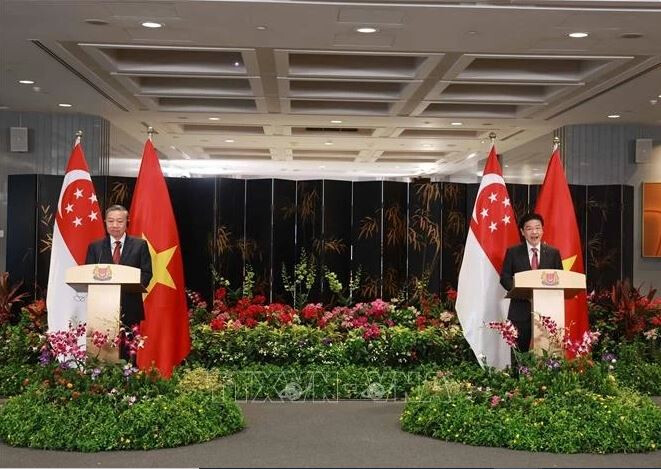
Hanoi, Vietnam – Vietnam and Singapore have upgraded their bilateral relations to a Comprehensive Strategic Partnership (CSP) in 2025, marking a significant milestone in their long-standing relationship that traces back to the 19th-century colonial era. This enhancement reflects the deepening cooperation across various sectors, addressing modern challenges such as technological innovation, environmental sustainability, and regional security.
Historical Context and Partnership Evolution:
The trade ties between Vietnam and Singapore originated during the French and British colonial periods. Following Vietnam's reunification in 1975, the two nations established formal diplomatic relations, aiming to strengthen economic and political ties. Vietnam's accession to ASEAN in 1995 further propelled their collaboration. In 2013, they forged a Strategic Partnership, focusing on economic cooperation, defense, education, science, technology, and regional collaboration. The 2025 elevation to a CSP underscores their commitment to addressing contemporary challenges and solidifying their bond.
Understanding the Comprehensive Strategic Partnership (CSP):
A CSP is a high-level formal agreement between two or more parties to foster extensive cooperation across key sectors. It aims to build stronger bilateral relations by addressing common challenges and expanding existing agreements to include new areas. The Vietnam-Singapore CSP emphasizes renewable energy, artificial intelligence technology, submarine cable development, and other critical infrastructure projects. Aligning national goals and policies, it seeks to tackle global challenges more effectively.
Key Areas of Cooperation Under the CSP:
Economic and Trade Relations:Bilateral trade has consistently grown, reaching $23.5 billion in 2024. Singapore is a major investor in Vietnam, contributing nearly 30% of Vietnam's Foreign Direct Investment (FDI) in recent years.
The CSP facilitates further trade expansion through projects like the joint investment in submarine fiber-optic cables by Singapore's Keppel Ltd and Vietnam's Sovico Group. This infrastructure enhances AI services and data centers, positioning both nations as key players in technological development.
Vietnam's emergence as a "China plus one" manufacturing hub further solidifies the economic importance of this partnership.
Technology and Innovation:The CSP strengthens cooperation in the digital economy and smart city initiatives. Singaporean companies like Shopee dominate Vietnam's e-commerce sector, reflecting the growing interest in Vietnam's digital ecosystem.
Singapore's involvement in Vietnam's urbanization includes integrating Ho Chi Minh City, Hanoi, and Da Nang into a regional network of smart cities focused on digital infrastructure and electronic payments.
Sustainability and Green Economy:Sustainability is a core focus of the CSP, particularly as ASEAN nations face rapid urbanization and climate change threats.
The expansion of the Vietnam-Singapore Industrial Park (VSIP) will include green energy investments, focusing on sustainability with rooftop solar installations and water treatment projects.
Cooperation in offshore wind power supports the transition to renewable energy and promotes cross-border electricity trading.
Singapore's role as a carbon services leader in Asia facilitates carbon trading and sustainability investments, furthered by the 2022 carbon credit trading agreement.
Defense and Security Cooperation:Military relations are deepening, especially in maritime security. Joint naval exercises focus on improving coordination in areas like search and rescue, anti-piracy efforts, and maritime law enforcement in the South China Sea.
People-to-People Exchanges and Educational Collaboration:The CSP includes initiatives to promote talent development and educational exchanges in fields like semiconductor technology and medical research.
Increased Technical and Vocational Education and Training (TVET) efforts and the launch of the Singapore-Vietnam Innovation Talent Exchange Program are key components.
Enhanced cooperation in culture, arts, and sports, along with tourism promotion, are also prioritized.
Strategic Implications for ASEAN and Beyond:
The Vietnam-Singapore CSP significantly enhances ASEAN's economic and political integration by fostering deep cooperation. It strengthens supply chain resilience and supports ASEAN's long-term economic goals in sustainability and innovation.
The CSP is likely to elicit varied responses from other regional powers. China, with strong economic ties to both nations, may view the partnership pragmatically. However, concerns may arise if cooperation extends to sensitive areas like cybersecurity, digital infrastructure, or maritime security in the South China Sea.
The United States is expected to view the CSP positively, as it strengthens ASEAN unity and aligns with U.S. strategic interests in the Indo-Pacific region. The partnership supports U.S. priorities such as trade diversification, supply chain security, and digital economy development.
Future Prospects and Challenges:
The Vietnam-Singapore CSP is poised for growth, with both nations achieving milestones in economic, technological, and political cooperation. However, challenges remain. Territorial disputes in the South China Sea could lead to regulatory issues, causing delays or increased costs for key projects like submarine cables. Economic obstacles, such as global recessions or supply chain disruptions, could slow progress in sectors like green energy. Additionally, Vietnam's transition from an export-based manufacturing economy to a technology-driven one may face difficulties, including the need for domestic innovation.
[Copyright (c) Global Economic Times. All Rights Reserved.]