![[등록] 2026-09-01 15:48:31](/support/_updata/banner2/tl181982910_6749.png)


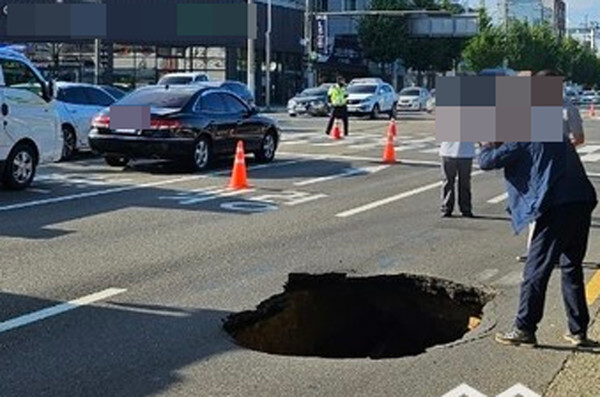
Seoul saw 73 ground subsidence (sinkhole) incidents in the first half of this year, meaning a sinkhole appeared every 2 to 3 days. Incidents were particularly concentrated in May due to sudden heavy rainfall, and the Gangnam area, where large-scale construction projects are frequent, experienced the highest number of sinkholes, raising growing concerns about ground safety.
According to the Seoul Metropolitan Government's disaster and safety portal, "Seoul Safety Nuri," out of the 73 sinkholes that occurred from January 1 to June 30, 2025, 26 incidents, or 36%, were in Gangnam, Seocho, and Songpa Districts. Specifically, Gangnam District had 13 cases, Songpa District 10, and Seocho District 3. The Seoul Metropolitan Government attributes the high rate of sinkhole occurrences in Gangnam District to frequent large-scale excavation work for high-rise building construction, subway projects, and redevelopment, as well as its proximity to the Han River, which makes the ground relatively weak.
A monthly analysis revealed that a staggering 44 sinkholes occurred in May, when Seoul experienced sudden heavy rainfall, leading to the closure of major rivers and roads. This is significantly higher compared to 3 cases in January, 4 in March, 12 in April, and 10 in June. No sinkholes occurred in February. It is presumed that the heavy rain caused water to seep underground, weakening the ground, or accelerated the erosion of soil due to cracks in old sewer pipes.
Primary Cause of Sinkholes: Deteriorated Sewer Pipes
Examining the main causes of sinkholes, damage to sewer pipes was the most frequent, accounting for 18 incidents. This was followed by sinkholes due to manhole damage (11 cases), storm drain damage (9 cases), and water pipe leaks (3 cases).
Of Seoul's total 18,666 km of sewer pipes, 6,029 km, or 55.5%, are over 30 years old. These aged sewer pipes are vulnerable to cracks and damage, allowing rainwater or groundwater to seep in, leading to the loss of surrounding soil and the formation of voids, which are a primary cause of sinkholes.
In the case of a large sinkhole that occurred in Myeongil-dong, Gangdong-gu, on March 24, the Ministry of Land, Infrastructure and Transport formed a Central Underground Accident Investigation Committee to conduct a precise investigation into its cause. Other sinkholes in Myeongil-dong, Gangdong-gu, were caused by poor compaction around underground utilities and soil loss due to aging sewer manholes. A sinkhole in Seongnae-dong was attributed to soil loss from a leak in the welded joint of a water supply pipeline's air valve connection. This indicates that sinkholes are not merely a localized issue but are related to the overall aging of underground infrastructure throughout Seoul.
Seoul's Response and Future Plans
The Seoul Metropolitan Government acknowledges the seriousness of the sinkhole problem and is preparing countermeasures. The city immediately investigates the cause of underground voids when they are 0.8㎡ or larger and 0.8m or deeper, or if they result in casualties, and transparently discloses the findings on Seoul Safety Nuri.
Furthermore, the city plans to invest a large budget for the maintenance of deteriorated sewer pipes. The Seoul Metropolitan Government intends to allocate an additional 200 billion won from its special account, along with disaster management funds, national funds, and general accounts, to invest 400 billion won annually. From the second half of this year until 2030, the city aims to maintain 200 km of old sewer pipes annually, replacing a total of over 1,200 km of deteriorated pipes to address the fundamental cause of sinkhole occurrences.
However, experts point out that simply replacing old sewer pipes is not enough; a continuous integrated underground space management system is also necessary. Given Seoul's characteristics of complex underground development, including subway construction, various communication cable installations, and water and sewage pipe replacements, there is a strong call for building comprehensive data on underground facility interference and complex ground environments. This data should then be used to strengthen prediction and prevention systems. Ongoing and proactive efforts from the Seoul Metropolitan Government are required to ensure citizen safety.
[Copyright (c) Global Economic Times. All Rights Reserved.]