• 2026.08.12 (Wed)
  • All articles
  • LOGIN
  • JOIN
Global Economic Times
fashionrunwayshow2026
  • Synthesis
  • World
  • Business
  • Industry
  • ICT
  • Distribution Economy
  • Well+Being
  • Travel
  • Eco-News
  • Education
  • Korean Wave News
  • Opinion
  • Arts&Culture
  • Sports
  • People & Life
    • International Student Report
    • With Ambassador
  • Column
    • Cho Kijo Column
    • Cherry Garden Story
    • Ko Yong-chul Column
    • Kim Seul-Ong Column
    • Lee Yeon-sil Column
  • Photo News
  • New Book Guide
MENU
 
Home > Business

Large-Scale Marts Under Fire for Deceptive Use of Government Vouchers

Hwang Sujin Reporter / Updated : 2025-08-20 11:56:58
  • -
  • +
  • Print


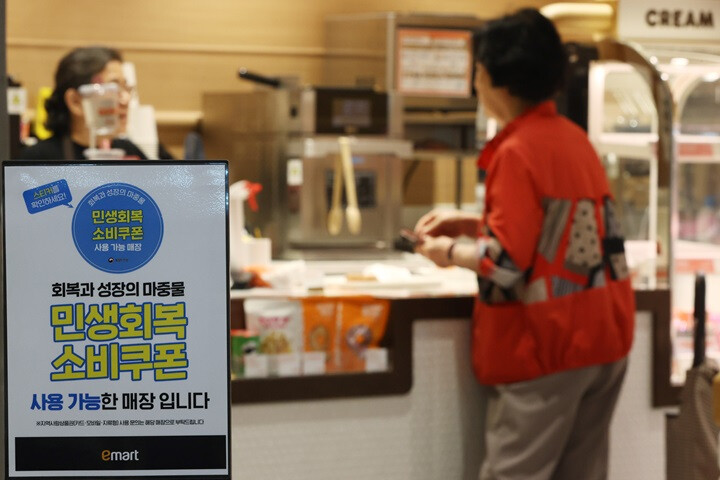
SEOUL—In a practice that has ignited outrage among small business owners, a growing number of large-scale food ingredient marts are facing allegations of illegally accepting government-issued consumption vouchers, a program designed to inject life into the local economy by supporting small merchants.

The controversy centers on a policy that restricts the use of these vouchers—part of a nationwide economic stimulus package—to businesses with an annual revenue of less than ₩3 billion. However, investigations and reports from industry groups reveal that some larger marts are exploiting loopholes to bypass this regulation, effectively siphoning off funds intended for smaller, struggling enterprises.

The Shell Game: A Form of Fraud 

According to a joint statement from the Korea Supermarket Cooperative Federation and the Korea Federation of Small and Medium Enterprises, these large establishments are engaging in sophisticated, and often brazen, forms of deceit. They are reportedly setting up "disguised affiliate stores" or "ghost corporations" within their premises. In some cases, a large mart, which well exceeds the ₩3 billion revenue threshold, might use a separate point-of-sale terminal from a smaller business—such as a fruit or vegetable stand operating within the same building—to process the coupon payments.

This "shell game" allows them to appear as a legitimate small-scale vendor, tricking both customers and the system itself. The small business associations noted a disturbing trend where these marts are even openly advertising the acceptance of the vouchers, creating an unfair competitive advantage.

Exposing the Deception 

The associations have vowed to take decisive action. They are initiating a nationwide campaign to gather reports of fraudulent activity and are planning to submit these findings to relevant local authorities. Their demands are clear: suspend the business operations of any fraudulent affiliates and, where appropriate, request full tax investigations from the National Tax Service.

Concrete examples of this malpractice are already surfacing. In Uijeongbu City, a large food mart was found to be using a separate business’s card terminal to accept voucher payments. Similarly, in Suwon City, a mart with revenues exceeding ₩10 billion reportedly created a new legal entity to install a dedicated terminal for voucher transactions, an act that constitutes illegal revenue splitting.

A representative from the small business federations stated, "This is a serious violation of the policy's intent. It not only undermines the purpose of the voucher program but also exacerbates the hardships faced by genuine small business owners who are already struggling to compete with these larger chains."

The Ministry of the Interior and Safety, which oversees the voucher program, has directed local governments to handle reports of fraud through their designated "fraudulent distribution reporting centers." If a business is confirmed to be a "disguised affiliate," their voucher-accepting status is revoked, and the information is shared with tax authorities.

While the Korea Mart Association acknowledged the problem and affirmed its commitment to guiding members toward compliance, it also voiced concerns. A spokesperson highlighted the delicate balance between preventing fraud and not creating new regulatory hurdles that could stifle the growth of small businesses that aspire to become mid-sized.

As the government continues its efforts to boost local economies, the battle against these deceptive practices remains a critical challenge. The small business community is united in its call for stricter enforcement and a level playing field, ensuring that government aid reaches those who need it most.

[Copyright (c) Global Economic Times. All Rights Reserved.]

  • #globaleconomictimes
  • #micorea
  • #mykorea
  • #Lifeplaza
  • #nammidonganews
  • #singaporenewsk
  • #Samsung
  • #Daewoo
  • #Hyosung
  • #A
Hwang Sujin Reporter

Popular articles

  • Japan Estimated to Have Spent ¥6–7 Trillion in Fresh Yen-Buying Intervention as US Joint Action Hints Emerge

  • South Korea’s Top Three Mobile Carriers Launch Pre-Orders for Samsung’s Galaxy Z Series with Aggressive Subsidies and Service Bundles

  • S. Korea Accelerates Leveraged ETF Rules: ₩30M Cash Deposit Required Starting July 31

I like it
Share
  • Facebook
  • X
  • Kakaotalk
  • LINE
  • BAND
  • NAVER
  • https://www.globaleconomictimes.kr/article/1065581784214136 Copy URL copied.
Comments >

Comments 0

Weekly Hot Issue

  • Riot Games Hosts Largest-Ever TFT Festival at The Hyundai Seoul to Launch 'Sylvan Secrets' Set
  • MINISTRY OF EMPLOYMENT AND LABOR DIRECTS IMMEDIATE EXPANSION OF REST FACILITIES AT GIMPO AIRPORT AFTER UNANNOUNCED HEATWAVE INSPECTION
  • XAVIS Secures Contract to Supply Advanced X-Ray Inspection Systems to European Lines of Global Food Sauce Brand
  • Emma Expands Collaboration with Interior Design Experts to Present Sleep Space Solutions
  • Trump Criticizes U.S. Congressional AI Regulations as Threat to Tech Industry
  • Memory Chips Become Dominant Force in Global Semiconductor Industry, Expected to Account for 60% of Total Market This Year

Most Viewed

1
Planting Hope: Ethiopia’s Green Legacy and the Power of National Transformation
2
Japan Estimated to Have Spent ¥6–7 Trillion in Fresh Yen-Buying Intervention as US Joint Action Hints Emerge
3
The 16th Ethiopia-gil World Festival & Meskel Festival
4
South Korea’s July Exports Hit Record $98.9 Billion as Semiconductor Supercycle Powers Surge
5
Lube Base Oil Emerges as Export Lifesaver for South Korean Refiners Amid Middle East Conflict
광고문의
임시1
임시3
임시2

Hot Issue

MINISTRY OF EMPLOYMENT AND LABOR DIRECTS IMMEDIATE EXPANSION OF REST FACILITIES AT GIMPO AIRPORT AFTER UNANNOUNCED HEATWAVE INSPECTION

Riot Games Hosts Largest-Ever TFT Festival at The Hyundai Seoul to Launch 'Sylvan Secrets' Set

Nable Communications Secures 5G Private Network Upgrade Deal with LG Uplus

Ansan City Pay-as-You-Throw Trash Bag Abandoned in Japan Sparks Controversy in Kamikochi

Fashion Runway Show 2026

Global Economic Times
korocamia@naver.com
CEO : LEE YEON-SIL
Publisher : KO YONG-CHUL
Registration number : Seoul, A55681
Registration Date : 2024-10-24
Youth Protection Manager: KO YONG-CHUL
Singapore Headquarters
5A Woodlands Road #11-34 The Tennery. S'677728
Korean Branch
Phone : +82(0)10 4724 5264
#304, 6 Nonhyeon-ro 111-gil, Gangnam-gu, Seoul
Copyright © Global Economic Times All Rights Reserved
  • 향기네무료급식
  • BCB부천방송
  • 반달곰 프로젝트
Search
Category
  • All articles
  • Synthesis
  • World
  • Business
  • Industry
  • ICT
  • Distribution Economy
  • Well+Being
  • Travel
  • Eco-News
  • Education
  • Korean Wave News
  • Opinion
  • Arts&Culture
  • Sports
  • People & Life 
    • 전체
    • International Student Report
    • With Ambassador
  • Column 
    • 전체
    • Cho Kijo Column
    • Cherry Garden Story
    • Ko Yong-chul Column
    • Kim Seul-Ong Column
    • Lee Yeon-sil Column
  • Photo News
  • New Book Guide
  • Multicultural News
  • Jobs & Workers