• 2025.12.11 (Thu)
  • All articles
  • LOGIN
  • JOIN
Global Economic Times
APEC2025KOREA가이드북
  • Synthesis
  • World
  • Business
  • Industry
  • ICT
  • Distribution Economy
  • Well+Being
  • Travel
  • Eco-News
  • Education
  • Korean Wave News
  • Opinion
  • Arts&Culture
  • Sports
  • People & Life
  • Column
    • Cho Kijo Column
    • Lee Yeon-sil Column
    • Ko Yong-chul Column
    • Cherry Garden Story
  • Photo News
  • New Book Guide
MENU
 
Home > ICT

Unitree CEO Foresees "ChatGPT Moment" for Robotics Within Three Years

Greace Nunez Correspondent / Updated : 2025-08-11 14:23:35
  • -
  • +
  • Print

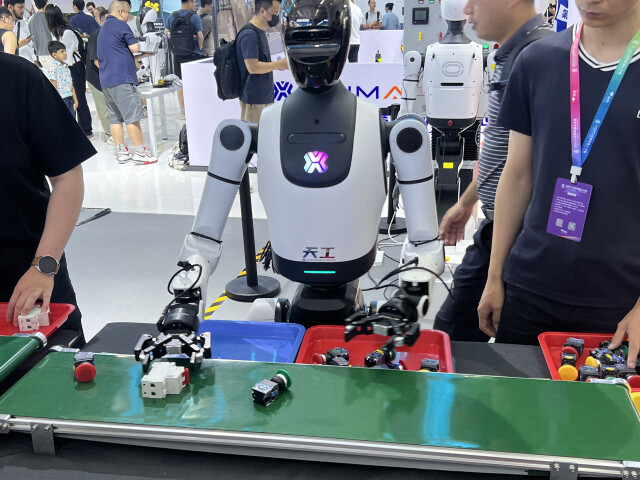
BEIJING – Wang Xingxing, the CEO of leading Chinese robotics company Unitree, has boldly predicted that a "ChatGPT moment" for the humanoid robot industry could arrive as early as the next three years. Speaking at the 2025 World Robot Conference forum in Beijing, Wang drew a parallel between the current state of embodied intelligence and the period just before the advent of large language models like ChatGPT.

According to a report by Caixin and other Chinese media outlets, Wang noted that the Chinese robotics sector has seen significant growth in the first half of this year, with manufacturers of both components and finished products experiencing an average growth of 50-100%. He stated, "The current stage of embodied intelligence is like the one to three years before ChatGPT's birth."

Wang defined the critical threshold for embodied intelligence as a humanoid robot's ability to understand and execute arbitrary commands from a user in an unfamiliar environment. He expressed confidence that this milestone is highly likely to be reached within three to five years, and potentially even sooner.

Challenging the prevailing industry consensus, Wang contended that the primary hurdle for embodied intelligence is not a scarcity of data, but rather a deficiency in the model architectures needed to effectively utilize that data. He explained that while the hardware for robots is sufficiently developed, the intelligence of embodied systems lags far behind that of language models. He further argued that the "scaling law," which posits that AI performance improves with increased data and computation, has not yet been established for embodied intelligence, necessitating a separate training model for each task.

Wang pointed to Google's recently announced "Genie3" model as a promising development. He described it as a video-driven world model that could allow robot companies to control their machines in real-world environments using similar video-generated models. He revealed that Unitree is already actively pursuing such an approach. This perspective offers a new direction for the industry, suggesting that architectural innovation, not merely data volume, will be the key to unlocking the next generation of intelligent robots.

[Copyright (c) Global Economic Times. All Rights Reserved.]

  • #globaleconomictimes
  • #micorea
  • #mykorea
  • #Lifeplaza
  • #nammidonganews
  • #singaporenewsk
  • #Samsung
  • #Daewoo
  • #Hyosung
  • #A
Greace Nunez Correspondent

Popular articles

  • Trump Considers Halting Federal Aid to NYC Following Mamdani's Mayoral Victory

  • US-Ukraine Officials Meet in Florida to Finalize Peace Proposal Amid Russian Onslaught

  • Honduras Election Chaos: Tensions Rise Amid Recount and Fraud Claims

I like it
Share
  • Facebook
  • X
  • Kakaotalk
  • LINE
  • BAND
  • NAVER
  • https://www.globaleconomictimes.kr/article/1065590588116604 Copy URL copied.
Comments >

Comments 0

Weekly Hot Issue

  • Won-Dollar Exchange Rate Rises to 7-Month High: South Korean Authorities Scramble to Stabilize Currency as Overseas Investment Surges
  • South Korea Confirmed as Co-Host of 2028 UN Ocean Conference (UNOC)
  • Netflix Stock Plummets 10% on Credit Downgrade Fears Following Blockbuster Warner Bros. Acquisition
  • Tech Tensions Flare: DeepSeek Allegedly Smuggles Banned NVIDIA Blackwell Chips for New AI Model
  • From Court to Content: French Tennis Star Océane Dodin Trades Racquet for OnlyFans, Eyes $5M in a Year
  • Alibaba's AI Ascent: Stock Soars 70% as Tech Giant Pivots Beyond E-commerce

Most Viewed

1
Korean War Ally, Reborn as an 'Economic Alliance' Across 70 Years: Chuncheon's 'Path of Reciprocity,' a Strategic
2
A Garden Where the City's Rhythm Stops: Dongdaemun's 'Cherry Garden', Cooking Consideration and Diversity
3
The Sudden Halt of Ayumi Hamasaki's Shanghai Concert: Unpacking the Rising Sino-Japanese Tensions
4
Alliance in a Dilemma: The Fallout of Trump's Advice to Takaichi Not to 'Provoke Taiwan' 
5
The Paradox of the 'Juvenile Offender' (Chokbeop Sonyeon): Impunity or Unfinished Rehabilitation?
광고문의
임시1
임시3
임시2

Hot Issue

Tech Tensions Flare: DeepSeek Allegedly Smuggles Banned NVIDIA Blackwell Chips for New AI Model

Samsung SDI Secures Multi-Trillion Won LFP Battery Deal, Marking Full-Scale Entry into US ESS Market

Netflix Stock Plummets 10% on Credit Downgrade Fears Following Blockbuster Warner Bros. Acquisition

LG Innotek Develops Eco-Friendly Next-Gen Smart IC Substrate, Reducing Carbon Emissions by Half

Let’s recycle the old blankets in Jeju Island’s closet instead of incinerating them.

Global Economic Times
korocamia@naver.com
CEO : LEE YEON-SIL
Publisher : KO YONG-CHUL
Registration number : Seoul, A55681
Registration Date : 2024-10-24
Youth Protection Manager: KO YONG-CHUL
Singapore Headquarters
5A Woodlands Road #11-34 The Tennery. S'677728
Korean Branch
Phone : +82(0)10 4724 5264
#304, 6 Nonhyeon-ro 111-gil, Gangnam-gu, Seoul
Copyright © Global Economic Times All Rights Reserved
  • 에이펙2025
  • APEC2025가이드북TV
  • 독도는우리땅
Search
Category
  • All articles
  • Synthesis
  • World
  • Business
  • Industry
  • ICT
  • Distribution Economy
  • Well+Being
  • Travel
  • Eco-News
  • Education
  • Korean Wave News
  • Opinion
  • Arts&Culture
  • Sports
  • People & Life
  • Column 
    • 전체
    • Cho Kijo Column
    • Lee Yeon-sil Column
    • Ko Yong-chul Column
    • Cherry Garden Story
  • Photo News
  • New Book Guide
  • Multicultural News
  • Jobs & Workers