![[등록] 2026-09-01 15:48:31](/support/_updata/banner2/tl181982910_6749.png)


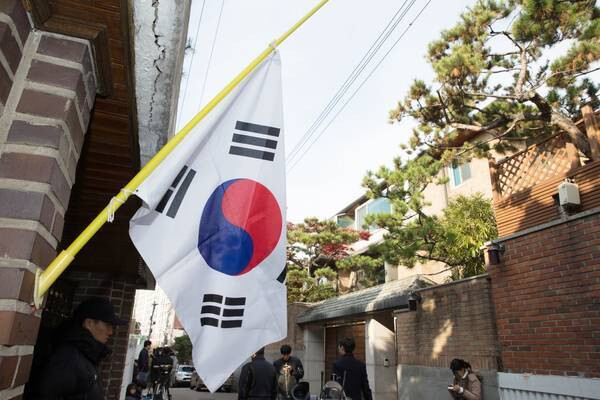
With October—a month packed with major national holidays like Armed Forces Day, National Foundation Day, and Hangeul Day—approaching, the household tradition of hoisting South Korea's national flag, the Taegeukgi, is rapidly disappearing.
Experts point out that an urgent, practical countermeasure is needed to preserve the flag-hoisting culture, as it faces indifference from the younger generation amidst changing residential environments and a lack of official statistics.
The Taegeukgi is a representative symbol of national pride, created during the Japanese colonial period to preserve South Korea's identity and sovereignty. The deepening trend of ignoring even the seven official flag-hoisting days per year is concerning, as it could lead to a weakening of national identity.
Critics emphasize that an urgent strategy is needed to revive the fading tradition, especially given the absence of official government statistics on flag ownership and hoisting rates, coupled with shifting housing structures and altered perceptions of the national flag.
Under the Republic of Korea Flag Act, the five major national holidays (March 1st Movement Day, Constitution Day, Liberation Day, National Foundation Day, and Hangeul Day), along with Memorial Day and Armed Forces Day, are designated as flag-hoisting days.
However, because these are mere recommendations without legal enforcement, the culture of hoisting flags to honor patriotic martyrs and reflect on the meaning of national holidays is steadily losing momentum.
Furthermore, there are no official government statistics regarding national flag ownership or hoisting rates, leaving the matter dependent on sporadic surveys conducted by private organizations or local governments.
According to a 2002 "Thegeukgi Hoisting Behavior and Perception Survey" conducted by Hankook Research on 1,000 adults aged 18 and older nationwide, only 47% of respondents reported hoisting the flag on national holidays over the previous year (19% always, 28% frequently).
The indifference among the younger generation was particularly severe.
Seventy percent of individuals aged 18 to 29 and 65% of those in their 30s answered that they "do not hoist the Taegeukgi," revealing that roughly two out of three young people fail to display the flag on national holidays.
The primary reasons cited for not hoisting the flag were the lack of a Taegeukgi at home (37%) and the lack of a proper space to hang it (21%).
A drop in household flag ownership, combined with modern architectural changes in newly built apartments—such as floor-to-ceiling windows without traditional balconies—has fueled the decline in hoisting rates.
Additionally, the expansion of a digital hoisting culture—where people share images of the Taegeukgi on social network services (SNS) instead of using physical flags—has also played a role.
Lee Tae-yeop (32), a resident of Sejong City, remarked, "I'm not even sure if we have a Taegeukgi at home, and modern apartments don't even have a place to insert a flag pole. I only realize the date when I see acquaintances posting Taegeukgi images on social media during national holidays, and I don't feel any necessity to actually hang a flag at home."
[Copyright (c) Global Economic Times. All Rights Reserved.]