• 2026.05.08 (Fri)
  • All articles
  • LOGIN
  • JOIN
Global Economic Times
fashionrunwayshow2026
  • Synthesis
  • World
  • Business
  • Industry
  • ICT
  • Distribution Economy
  • Well+Being
  • Travel
  • Eco-News
  • Education
  • Korean Wave News
  • Opinion
  • Arts&Culture
  • Sports
  • People & Life
    • International Student Report
    • With Ambassador
  • Column
    • Cho Kijo Column
    • Cherry Garden Story
    • Ko Yong-chul Column
    • Kim Seul-Ong Column
    • Lee Yeon-sil Column
  • Photo News
  • New Book Guide
MENU
 
Home > Business

Vietnamese Auto Industry Seeks to Boost Local Production Amidst Import Reliance

Global Economic Times Reporter / Updated : 2025-01-11 16:16:21
  • -
  • +
  • Print

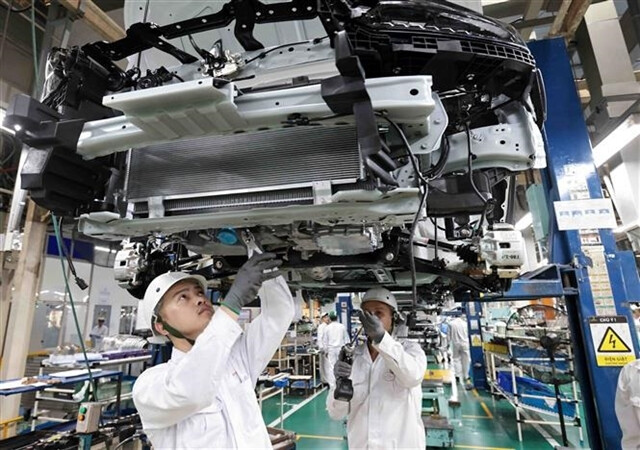
Hanoi - Despite boasting 377 automobile enterprises, including numerous foreign direct investments (FDIs), Vietnam's automotive industry heavily relies on imports, sourcing around 80% of its production components. This reliance, according to local experts, hinders the industry's competitiveness and necessitates urgent strategies to increase the localization rate.

Currently, the production value of Vietnam's automotive supporting industry constitutes a mere 2.7% of the overall industry value, significantly lagging behind regional standards. The limited number of local suppliers – fewer than 100 tier 1 and 150 tier 2 and 3 – further exacerbates this issue.   

"The focus on long-term strategies to foster a stronger local supply chain will be crucial for Vietnam to position itself as a competitive player in the global automotive market," emphasized Lê Ngọc Anh, Director of VinFast.

Challenges and Opportunities

One major challenge stems from the discrepancy in corporate tax rates. While local enterprises face tax rates starting at 25%, foreign companies enjoy a lower 10% rate, creating an uneven playing field.   

However, VinFast, a leading Vietnamese automaker, is spearheading efforts to enhance localization. With a current localization rate exceeding 60% for electric vehicles, the company aims to increase this to 84% by 2026. This includes producing key components like seats, wiring, and brake-steering systems domestically.   

Collaboration and Innovation

VinFast is actively collaborating with both domestic and foreign enterprises to strengthen the local supply chain. This includes partnerships with domestic parts manufacturers, logistics providers, and FDI companies possessing advanced technologies and management practices.   

"VinFast's efforts contribute to building a robust ecosystem that supports sustainable economic growth in Vietnam," stated Dr. Bùi Quang Tuấn, an economist.

Conclusion

Increasing the localization rate is crucial for the sustainable growth of Vietnam's automotive industry. By fostering a strong local supply chain through collaboration, innovation, and favorable policies, the country can enhance its competitiveness in the global market and drive economic development.

[Copyright (c) Global Economic Times. All Rights Reserved.]

  • #globaleconomictimes
  • #seoulkorea
  • #periodicoeconomico
  • #글로벌이코노믹타임즈
  • #GET
  • #GETtv
  • #대한민국
  • #중기청
  • #재외동포청
  • #외교부
  • #micorea
  • #my
Global Economic Times Reporter
Reporter Page

Popular articles

  • From the Alps to Seoul: Life in the Heart of Europe

  • BOK Holds Rate Steady for Seventh Consecutive Meeting, Signaling End of Easing Cycle

  • Welcome to Cherry Garden Restaurant!  

I like it
Share
  • Facebook
  • X
  • Kakaotalk
  • LINE
  • BAND
  • NAVER
  • https://www.globaleconomictimes.kr/article/1065597283197831 Copy URL copied.
Comments >

Comments 0

Weekly Hot Issue

  • Hyundai Mobis Completes Independent EV 'Heart' Lineup: A Major Leap Toward Global Leadership in Power Electric Systems
  • OpenAI Redefines Human-AI Interaction with ‘GPT-Realtime-2’ and New Suite of Live Voice Models
  • Tensions Flare in Strait of Hormuz: U.S.-Iran Clashes Threaten Fragile Truce
  • UAE Sovereign Wealth Giants Descend on Seoul to Forge Strategic AI Alliance
  • U.S. Trade Court Strikes Down Trump’s ‘Global 10% Tariff,’ Citing Executive Overreach
  • POSTECH Researchers Double Metal-Polymer Adhesion via 3D Printing Surface Control

Most Viewed

1
Iran Imposes Transit Fees on Strait of Hormuz Amid Escalating Maritime Tensions
2
Korea and Vietnam Forge Strategic Partnership in Science, Technology, and Innovation
3
80% of Enterprises Hit by 'AI Agent Anomalies': SailPoint Calls for Integrated Identity Governance
4
Kurly Abandons 'All-Paper' Packaging Strategy Amid Rising Cost Pressures
5
Tradition Meets the Public: Chungju’s Gugak Busking
광고문의
임시1
임시3
임시2

Hot Issue

Tensions Flare in Strait of Hormuz: U.S.-Iran Clashes Threaten Fragile Truce

Tesla Model Y Becomes First to Pass Grueling New U.S. Autonomous Safety Tests

U.S. Trade Court Strikes Down Trump’s ‘Global 10% Tariff,’ Citing Executive Overreach

Hyundai Motor Group Bets $700 Million on Mexico Amid Trade Policy Volatility

Fashion Runway Show 2026

Global Economic Times
korocamia@naver.com
CEO : LEE YEON-SIL
Publisher : KO YONG-CHUL
Registration number : Seoul, A55681
Registration Date : 2024-10-24
Youth Protection Manager: KO YONG-CHUL
Singapore Headquarters
5A Woodlands Road #11-34 The Tennery. S'677728
Korean Branch
Phone : +82(0)10 4724 5264
#304, 6 Nonhyeon-ro 111-gil, Gangnam-gu, Seoul
Copyright © Global Economic Times All Rights Reserved
  • 에이펙2025
  • APEC2025가이드북TV
  • 반달곰 프로젝트
Search
Category
  • All articles
  • Synthesis
  • World
  • Business
  • Industry
  • ICT
  • Distribution Economy
  • Well+Being
  • Travel
  • Eco-News
  • Education
  • Korean Wave News
  • Opinion
  • Arts&Culture
  • Sports
  • People & Life 
    • 전체
    • International Student Report
    • With Ambassador
  • Column 
    • 전체
    • Cho Kijo Column
    • Cherry Garden Story
    • Ko Yong-chul Column
    • Kim Seul-Ong Column
    • Lee Yeon-sil Column
  • Photo News
  • New Book Guide
  • Multicultural News
  • Jobs & Workers