![[등록] 2026-09-01 15:48:31](/support/_updata/banner2/tl181982910_6749.png)


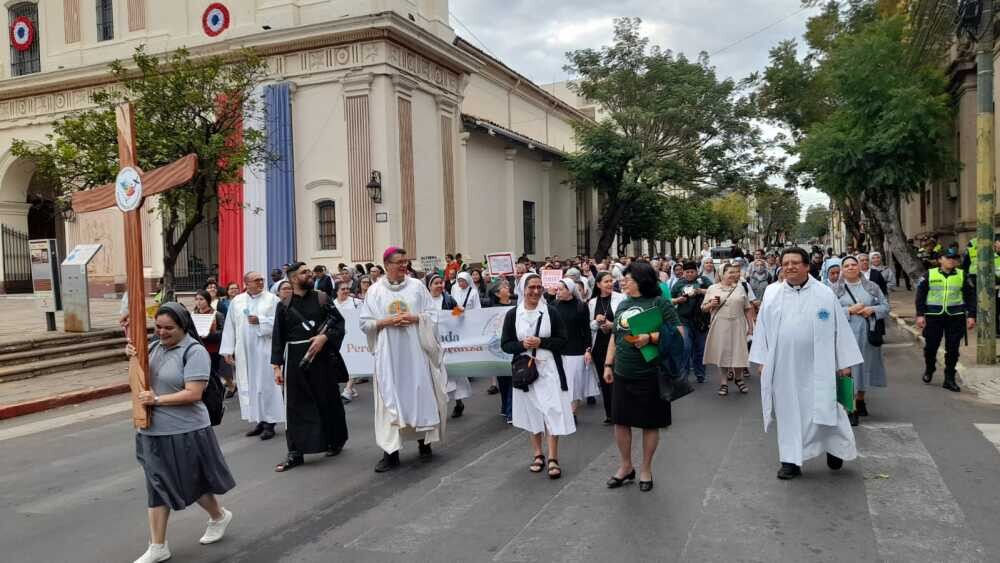
The annual pilgrimage of the Paraguayan Conference of Religious (Conferpar) exposed the fragility of democracy, issuing a stark warning about the risk of authoritarian regression. This alarming incident involved police censorship and an attempt to forcibly disperse a priest carrying a sign, raising serious concerns about freedom of expression and democratic values.
As part of Conferpar's annual "National Week of Consecrated Life," religious individuals released a statement during the pilgrimage, proclaiming, "The peace of Jesus Christ we announce is not the absence of conflict, but a commitment to human dignity and a solidarity at the margins of suffering and exclusion." They emphasized the need to be witnesses to the Kingdom of God "where life cries out in the faces of forgotten indigenous people, peasant communities dispossessed of their land, neglected marginalized residents, children without a future, wandering youth, elderly without support, abused women, and migrants without rights."
The religious also expressed deep concern over several major issues facing the nation. They criticized the underfunding and instability of public education, a public healthcare system that fails to guarantee the right to life, a shortage of personnel, medicine, and infrastructure, and the reality of the poor having to beg for basic medical services.
They highlighted the exploitation, marginalization, and racism experienced by indigenous peoples, alongside delays in agrarian reform, the proliferation of large-scale farms, and the criminalization of peasant movements. They also raised their voices against deforestation, unemployment, lack of opportunities, and the reality of young people easily exposed to addiction and violence due to a lack of hope. Above all, they strongly condemned political apathy, corruption, impunity, and the widespread infiltration of mafia, drug trafficking, and organized crime within state institutions, pointing to the absence of the common good.
After the mass, the religious proceeded with a pilgrimage to the Microcentro area around the National Congress, where the incident took a turn that recalled the grim authoritarian past. Father Alberto Luna, a Jesuit priest participating in the pilgrimage, was stopped by police. The police took issue with a sign he was holding that read "Immediate public transport reform!" and threatened him with arrest if he did not put it down.
Father Luna described the situation, stating, "Conferpar's pilgrimage was to express our concerns about the problems we face in this country and the lack of action by authorities for the poor." He added, "While we were walking, we were encouraged to carry signs expressing the reality of this country." Upon arriving next to Congress, police stopped Father Luna and threatened him with arrest if he continued to hold the sign. Father Luna ultimately decided to put the sign down to avoid disrupting the pilgrimage.
He was subsequently labeled an "intruder," and Deputy Minister of Interior Óscar Pereira claimed that "processions cannot be used for political purposes." (Reported by Última Hora, July 22, 2025).
This incident is unacceptable in a democratic society and brings to mind the grim past of Alfredo Stroessner's dictatorship. We must never allow an authoritarian regression, especially after 36 years of democracy achieved through the blood and sweat of the Paraguayan people. No sector—be it political, economic, or religious—should remain indifferent to serious social debt, the absence of justice, corruption, impunity, and the mafia, drug trafficking, and organized crime that have permeated state institutions.
Freedom of opinion, freedom of expression, and freedom of assembly are the core pillars of democracy. Prohibiting Paraguayan citizens from demanding a better public transportation system is a clear manifestation of authoritarianism, contrary to democracy and the rule of law. This incident serves as a crucial reminder that Paraguayan society must continuously strive to uphold democratic values and guarantee the fundamental rights of its citizens.
[Copyright (c) Global Economic Times. All Rights Reserved.]