
![[등록] 2026-09-01 15:48:31](/support/_updata/banner2/tl181982910_6749.png)


(C) Linkedin
HOUSTON — The battlefield for Artificial Intelligence is shifting from chatbots and silicon chips to the grease and gears of the global manufacturing floor. In a move to define the next generation of industrial production, NVIDIA and Dassault Systèmes have announced a landmark partnership to develop an AI-driven "Industrial World Model," effectively positioning themselves to dominate the Operating System (OS) of the future factory.
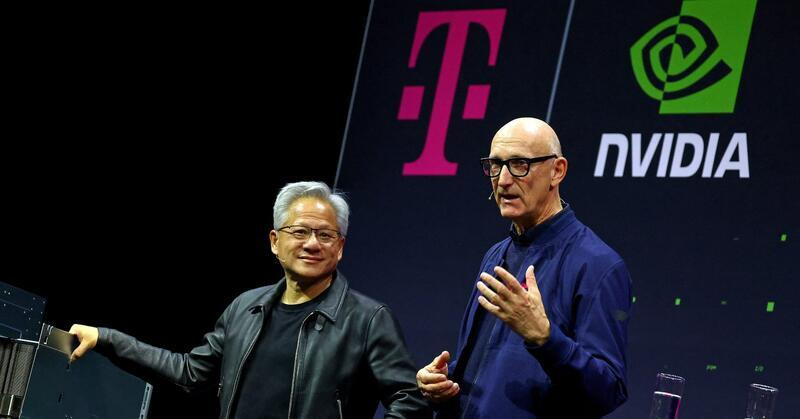
At the 3DEXPERIENCE World 2026 conference held in Houston on February 3rd, NVIDIA CEO Jensen Huang and Dassault Systèmes CEO Pascal Daloz took the stage to outline a vision where "Virtual Twins" and accelerated computing converge. The goal is to create a seamless digital environment where robots and humans coexist, governed by a "brain" capable of simulating physical reality with absolute precision.
The Shift: From Large Language Models to World Models
Jensen Huang declared that the world has entered a phase of "re-industrialization," noting that the demand for GPUs is migrating from AI model developers like OpenAI toward industrial giants.
"AI will become the foundational infrastructure of every industry, much like water, electricity, and the internet," Huang stated. He highlighted a historical trifecta currently in motion: the simultaneous expansion of semiconductor plants producing AI chips, computer factories assembling the hardware, and "AI Factories" that run the intelligence itself.
While Large Language Models (LLMs) excel at processing text, they often fail to grasp the nuances of the physical world. Pascal Daloz explained that for high-stakes industries like aerospace and defense, linguistic data isn't enough. "Physics—inertia, friction, and gravity—cannot be learned through text alone," Daloz said. By integrating NVIDIA’s computing power with Dassault’s virtual twin technology, the partners aim to build a World Model where AI can undergo millions of trial-and-error cycles in a digital space before a single bolt is turned in reality.
The Battle for the 'Manufacturing Brain'
The competition to set the standard for the AI Factory is becoming a "clash of titans." While industrial software incumbents like Siemens and Dassault provide the simulation depth, cloud giants like Microsoft (Azure) and Amazon Web Services (AWS) are providing the scale.
NVIDIA’s strategy involves using its Omniverse platform to unify previously fragmented software—such as Computer-Aided Design (CAD), Engineering (CAE), and Manufacturing Execution Systems (MES)—into a single, real-time integrated OS. This allows companies to train AI models in a simulated environment even if they lack extensive physical data, effectively lowering the barrier to entry for smart manufacturing.
South Korea’s Dilemma: Opportunity vs. Dependency
For South Korea, a global manufacturing powerhouse in semiconductors, automobiles, and batteries, this shift presents both a golden opportunity and a strategic threat.
The Opportunity: Global software leaders are eager to partner with Korean manufacturers to validate their AI models. LG Group, for instance, has already been collaborating with Siemens to optimize production lines via digital twin technology.
The Threat: Experts warn of "Software Dependency." If the "manufacturing intelligence" that controls a factory is owned by a foreign platform, Korean companies risk becoming mere hardware providers.
"The axis of manufacturing competitiveness is moving from physical equipment to the software and models that interpret and control them," noted Cha Suk-won, a professor of mechanical engineering at Seoul National University. "Even if the factory is on Korean soil, the 'brain' could be tethered to a foreign platform."
Defending the 'Manufacturing Recipe'
In response, South Korean leaders like Samsung Electronics and Hyundai Motor are pursuing a "Two-Track" strategy. While they utilize NVIDIA’s high-performance chips for raw computing power, they are investing heavily in developing their own proprietary "Manufacturing Recipes" and process models.
The industry consensus is clear: In the era of the AI Factory, the winner is not necessarily the one who owns the land or the machines, but the one who holds the keys to the Industrial World Model and the operating system that runs it.
[Copyright (c) Global Economic Times. All Rights Reserved.]














