![[등록] 2026-09-01 15:48:31](/support/_updata/banner2/tl181982910_6749.png)


Argentine President Javier Milei's decision to lift currency controls after securing billions of dollars in loans from the International Monetary Fund (IMF) and other international financial institutions is being evaluated as a "bold" move amidst a complex global economic situation. However, concerns are being raised about the potential for a sharp devaluation of the Argentine peso and a deepening of inflation.
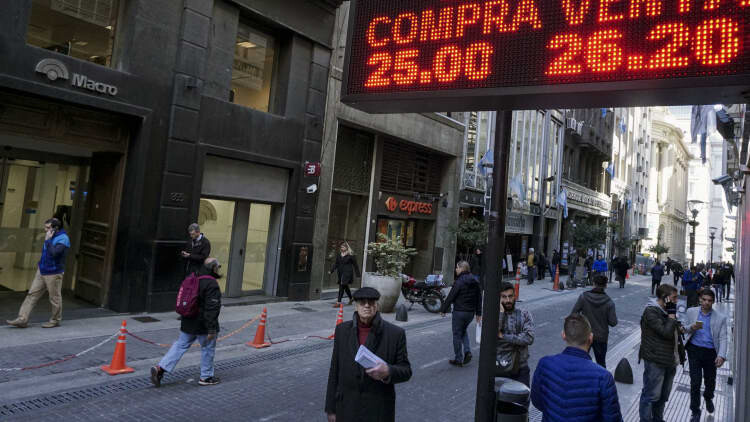
According to the announcement on the 12th, Argentine citizens will be free from most restrictions on access to foreign currency starting next week. A new floating exchange rate regime will be introduced, operating without central bank intervention as long as it remains below 1,400 pesos per dollar.
Leonardo Piazza, head of the economic consulting firm LP Consulting, stated in an interview with EFE, "This measure is very unorthodox and surprising. The government had no other choice but to implement a bold plan. Especially considering that the central bank's foreign exchange reserves have almost doubled with the support of the IMF and other international organizations, now was the appropriate time."
Recently, investors and experts have judged that the official exchange rate is divorced from reality and that the central bank's foreign exchange reserves are insufficient, leading to increased demand for foreign currency and expectations of devaluation.
The Argentine Central Bank's foreign exchange reserves have decreased by a total of $4.9 billion in 2025, closing at $24.7 billion as of the 12th. Private consultants estimate that net foreign exchange reserves are around negative $9.5 billion.
On the 12th alone, the central bank spent $398 million to curb exchange rate pressure.
The agreement with the IMF is expected to play a key role in replenishing these foreign exchange reserves.
In addition to the $20 billion IMF loan, Argentina will receive additional loans of $12 billion from the World Bank Group and $10 billion from the Inter-American Development Bank.
Based on the bolstered foreign exchange reserves, the government is taking a gamble on introducing a floating exchange rate regime that fluctuates without central bank intervention.
Given that the dollar sold to the general public at the state-owned Banco Nación closed at 1,097.50 pesos per unit on the 12th, an adjustment of the official exchange rate and its subsequent pass-through to the prices of goods and services is expected from the 15th.
This implies a further increase in inflation, which rose by 3.7% monthly in March.
Piazza commented, "We will have to wait and see how inflation stabilizes in the second quarter. Considering the budget surplus, there is a very high probability of a shock. The government must increase social support for the most vulnerable groups facing food inflation."
According to experts, in the long term, this plan is "very good" and could be "successful" in normalizing the economy and attracting investment.
However, economist Pablo Tigani stated, "This new system is 'crazy' because it grants complete freedom to capital flight and 'meaningless income from anywhere,' and there will 'obviously' be a surge in devaluation that will be 'passed on at the price' of the real economy."
"I think it will be very short-lived," Tigani said in an interview with EFE.
The expert also expressed concern about additional debt, considering that Argentina's total external debt amounted to $276 billion at the end of 2024, of which approximately $41 billion corresponds to IMF loans. This will increase significantly in the short term.
Milei Government's "Gamble": What is the Future of the Argentine Economy?
The Milei government's decision to lift currency controls is a significant turning point that could have a major impact on the future of the Argentine economy. In the short term, economic turmoil is highly likely due to the devaluation of the peso and deepening inflation. However, in the long term, there is hope that economic normalization and the attraction of investment could create new growth engines for the Argentine economy.
However, with a heavy external debt burden and social instability being major challenges that need to be addressed, it remains uncertain whether the Milei government's "bold gamble" will succeed.
[Copyright (c) Global Economic Times. All Rights Reserved.]