CHEONGDO — In a major push to bolster climate resilience, Cheongdo County in North Gyeongsang Province has successfully secured 61 billion won ($44 million USD) in combined national and provincial funding. The grants will finance two major regional initiatives aimed at mitigating extreme weather risks and revitalizing local waterways.
County officials announced Tuesday that the region was selected for the Ministry of the Interior and Safety’s Comprehensive Living Sphere Wind and Flood Damage Improvement Project, as well as the Ministry of Environment’s Ecological River Restoration Project. Both initiatives are scheduled to break ground in 2027.
Local authorities emphasized that combining infrastructure-based disaster prevention with nature-based environmental restoration marks a proactive step toward future-proof climate adaptation.
Mitigating Flood Risks in Vulnerable Farming Communities
The larger of the two initiatives, accounting for 41.2 billion won, targets the Iseo-myeon area—specifically the villages of Gocheol-ri, Yangwon-ri, Chilgok-ri, and Daegok-ri—which have historically suffered from chronic flooding during heavy summer downpours.
The engineering plan involves upgrading 4.71 kilometers of the Daegokcheon Stream and 370 meters of local tributaries, alongside rebuilding six aging bridges. To fortify the area against flash floods and landslides, the county will also construct new drainage pump stations, retention basins, and stormwater networks, while installing slope stabilization structures and a real-time early warning alert system.
Once finished, the upgrades are expected to safeguard local residents, nearly 80 buildings, and surrounding agricultural lands from seasonal inundation, securing a stable environment for the region's prominent farming sector.
Revitalizing Gwanhacheon’s Aquatic Ecosystem
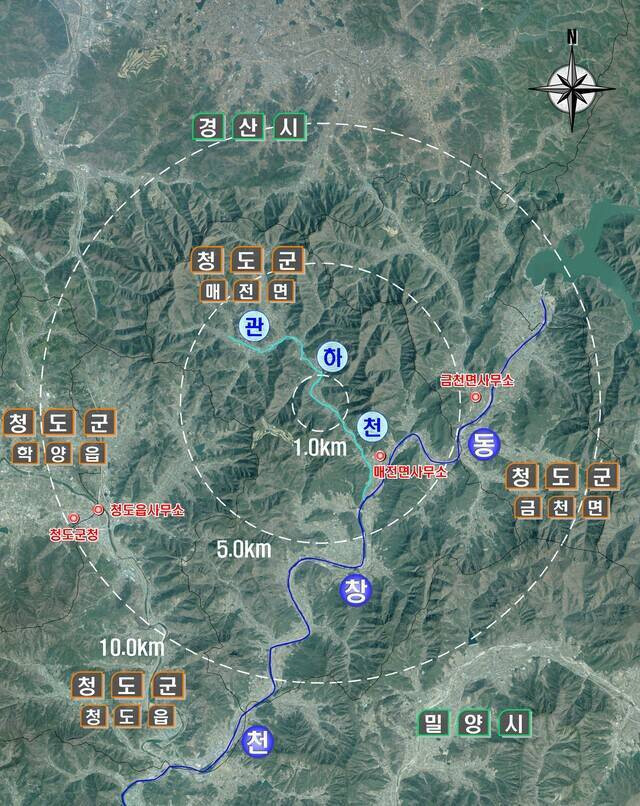
An additional 19.8 billion won has been allocated to restore the Gwanhacheon Stream, stretching from Dugok-ri in Maejeon-myeon to the Dongchangcheon confluence in Bukji-ri.
Designed to improve local water quality and revive biodiversity, the project will expand riparian green spaces and natural filtration zones. These measures are intended to counter potential non-point source pollution driven by nearby industrial development while strengthening the waterway's natural self-purification abilities. County planners noted that because roughly 86.6 percent of the target land is already publicly owned, administrative hurdles regarding land compensation and acquisition are expected to be minimal, allowing for faster project execution.
Embracing Nature-Based Solutions
Environmental experts have long advocated for integrated strategies that pair traditional flood control with ecological restoration to combat intensifying climate volatility. The expansion of riverside vegetation and green corridors is designed to enhance rainwater absorption, thereby flattening peak runoff volumes during extreme cloudbursts.
Cheongdo County Mayor Park Kwon-hyun highlighted the dual impact of the upcoming projects. "Securing these public funds gives us the momentum we need to build a safer, more livable waterfront environment," Park said. "We are committed to swiftly executing these plans to protect our citizens' lives and property while fostering a sustainable community where safety and nature thrive together."
[Copyright (c) Global Economic Times. All Rights Reserved.]