![[등록] 2026-09-01 15:48:31](/support/_updata/banner2/tl181982910_6749.png)


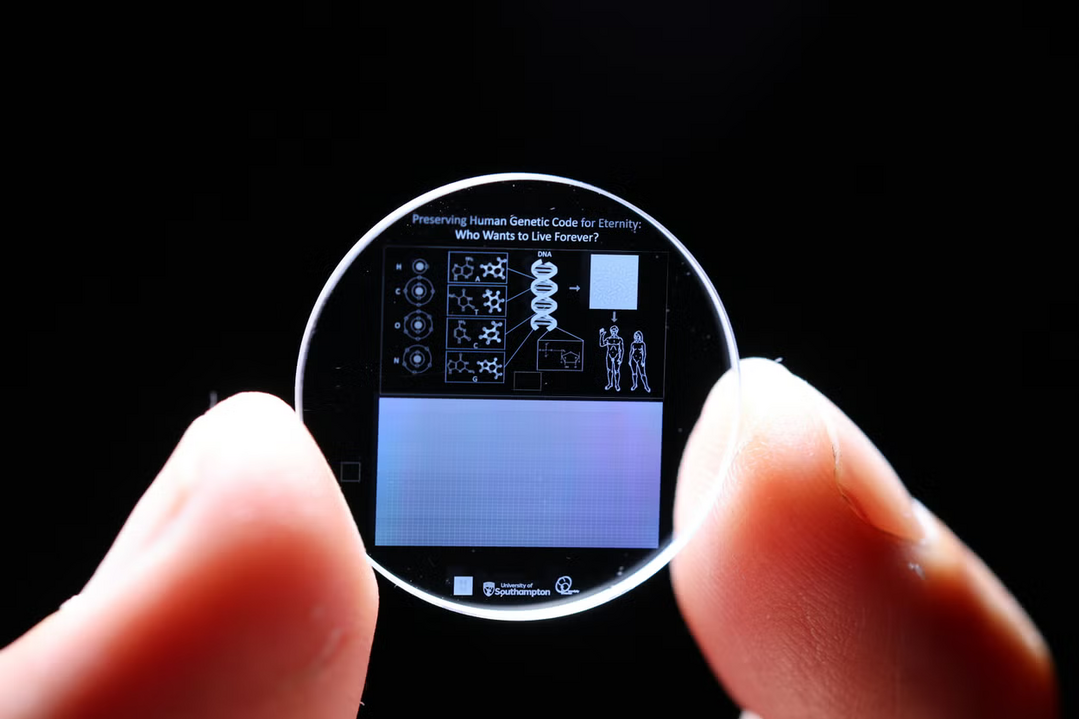
(C) TechRadar
POHANG, South Korea — In an era where a single high-definition photo consumes ten times more space than it did a decade ago, the digital world is facing a "silent crisis" of storage exhaustion. However, a research team at the Pohang University of Science and Technology (POSTECH) has unveiled a paradigm-shifting technology that could render the phrase "storage full" a relic of the past.
Breaking the Binary Barrier
Led by Professor Kyoung-Duck Park of the Department of Physics and the Department of Semiconductor Technology, the team has successfully developed an optical data storage method capable of holding hundreds of thousands of times more information than current commercial standards.
Traditional storage devices, such as Hard Disk Drives (HDDs) and USB flash drives, operate on a binary system. They function like simple light switches: a single cell is either "on" (1) or "off" (0). To store more data, manufacturers must cram more cells into a smaller area. However, as these cells shrink to the nanometer scale, they encounter "quantum tunneling" and electrical interference, physical barriers that have long threatened the limits of Moore’s Law.
The Magic of Excitons: Beyond 0 and 1
The POSTECH team bypassed these physical constraints by looking toward excitons. An exciton is a quasiparticle formed when a semiconductor absorbs a photon, causing an electron to bond with a "hole" (the absence of an electron). These particles possess characteristics of both light and matter.
Instead of treating a cell as a simple binary switch, the researchers treated it like a traffic light. Just as a traffic light conveys different instructions via red, yellow, and green, the team discovered they could precisely manipulate the physical states of excitons to represent multiple stages of information within a single cell.
"If traditional technology relied on expanding the physical territory of storage, our research focuses on utilizing the internal states of the exciton itself as the unit of information," explained Dr. Hyeongwoo Lee, the lead author of the study.
A Technical Masterpiece in Nano-Engineering
To achieve this, the team engineered a "Metal-Insulator-Semiconductor" (MIS) nano-tunnel junction device. By minutely controlling the flow of electrical charges through this sandwich-like structure, they forced excitons to transition into different particle states, which in turn changed the intensity of light they emitted.
Key Technical Achievements:
Multi-bit Logic: Successfully implemented three or more distinct light-emitting states within a single 60nm cell.
Extreme Thinness: The storage layer was reduced to under 15nm, allowing for high-density vertical stacking of devices.
Durability: Because the data is read and written using light (non-contact), physical wear and tear on the hardware are virtually eliminated.
From Data Centers to AI: A New Paradigm
The implications of this "Exciton Multi-bit Storage" are staggering. As AI services like generative models continue to flood servers with massive datasets, the energy and space required to maintain global data centers have become unsustainable.
Professor Park’s technology offers a path toward ultra-compact, high-capacity servers that consume less power and take up a fraction of the space. For the average consumer, this could mean smartphones with capacities reaching several petabytes, effectively ending the need to ever delete a photo or video.
A Global Collaboration
The research, which was featured as the cover story for the prestigious international journal ACS Nano, was a collaborative effort.
POSTECH: Led the measurement and device development (Kyoung-Duck Park, Hyeongwoo Lee, et al.).
Sungkyunkwan University: Provided the specialized 2D semiconductor materials (Professor Ki Kang Kim’s team).
University of Pennsylvania: Assisted in the complex result analysis (Professor Deep Jariwala’s team).
Supported by the National Research Foundation of Korea and the Samsung Science and Technology Foundation, this breakthrough signals a shift in the global semiconductor race, moving away from simple miniaturization and toward the sophisticated manipulation of quantum-level particles.
[Copyright (c) Global Economic Times. All Rights Reserved.]