![[등록] 2026-09-01 15:48:31](/support/_updata/banner2/tl181982910_6749.png)


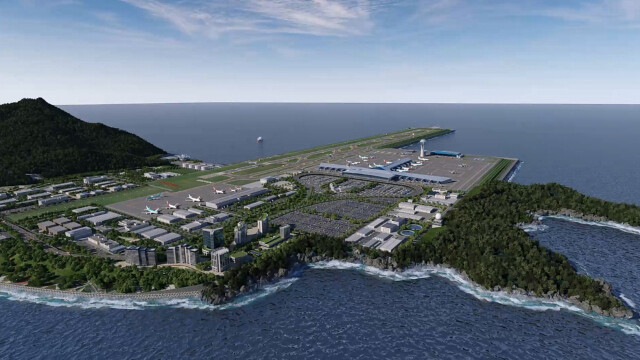
SEOUL, South Korea – Hyundai Engineering & Construction (Hyundai E&C) announced on May 30 that it will not participate in the land reclamation project for the Gadeokdo New Airport, citing the government's insistence on an unfeasible construction timeline. This decision marks a significant setback for the ambitious national project, which has already faced multiple delays and challenges.
Hyundai E&C, initially designated as the preferred bidder through a private contract after four failed competitive tenders, stated its inability to guarantee safety and quality within the stipulated timeframe. "Despite our efforts to ensure safety and quality, securing the necessary construction period to guarantee safety is impossible," the company said in a statement. "We have decided not to participate in the Gadeokdo New Airport land reclamation project."
The company further emphasized that accepting "unreasonable demands and conditions for a shortened construction period, which cannot ensure airport safety due to regional and political considerations," is unacceptable. This refers to the government's accelerated timeline, primarily driven by the aim to have the airport ready for the Busan World Expo 2030 bid, despite expert warnings about the project's inherent difficulties. Although Busan ultimately lost its bid to Riyadh, the urgency for the airport's completion has seemingly persisted.
A Project Fraught with Engineering Challenges
Hyundai E&C highlighted the immense complexity of the Gadeokdo project, describing it as an arduous undertaking involving the excavation of material equivalent to about three times the volume of Seoul's Namsan mountain and the creation of a site 2.3 times the size of Yeouido Island. The construction area on Gadeokdo Island, located off Busan's coast, is known for its unstable soft ground, which necessitates extensive stabilization measures and a longer period for settlement before large structures can be built.
The company stated that securing an adequate construction period is essential for ensuring both safety and quality. Hyundai E&C had invested approximately ₩60 billion (around $43 million USD) and engaged over 250 experts during the basic design phase, conducting in-depth technical reviews and analyzing similar international cases to determine an appropriate construction timeline. This extensive analysis led them to propose a 108-month (9-year) construction period, significantly longer than the 84 months (7 years) initially specified in the tender documents. Their proposal cited additional time needed for soft ground stabilization and partial breakwater construction before reclamation.
The Ministry of Land, Infrastructure and Transport (MOLIT) had previously urged Hyundai E&C to submit a revised plan aligning with the shorter timeline. However, with Hyundai E&C holding firm on its stance, MOLIT decided on May 8 to suspend the private contract procedures with the Hyundai E&C consortium.
Consortium Disarray and Future Uncertainties
Hyundai E&C also expressed frustration over what it termed "undue stigma" of delaying a national project for private gain. The company noted that MOLIT had already halted the private contract process, and local authorities and civic groups in Busan were demanding an immediate re-tender and their exclusion from future bids. Given these pressures, Hyundai E&C stated it would not participate.
To mitigate further delays and support the national project's success, Hyundai E&C announced it would waive all rights related to the basic design it developed and pledged full cooperation with the subsequent contractor selection process. The company clarified that this decision is solely its own, not that of the entire consortium, which includes Daewoo E&C and Posco E&C. By relinquishing its consortium rights, Hyundai E&C hopes to allow the remaining members to continue their participation, thereby minimizing project delays.
The withdrawal of the consortium's lead partner has prompted serious deliberations among the other participants. A Daewoo E&C official confirmed receiving notification of Hyundai E&C's decision and stated, "We need to reconcile the costs incurred so far and consider our next steps." Similarly, a Posco E&C official noted the uncertain path ahead, saying, "There are many possibilities for the future, but it's difficult to make an immediate judgment. Nothing has been decided yet. The consortium members will likely meet to discuss their opinions."
MOLIT maintains its stance, stating that Hyundai E&C's withdrawal does not alter its position. A ministry official reiterated, "There has been no change in our existing position. We continue to maintain our stance of initiating the suspension of the private contract procedure and exploring ways to normalize the project."
Broader Implications
Hyundai E&C's withdrawal underscores the inherent risks and complexities involved in large-scale infrastructure projects, particularly those under tight political deadlines and challenging geological conditions. The Gadeokdo New Airport project, envisioned as a key hub for Korea's southern region and a boost for Busan's global aspirations, faces significant challenges in finding a new contractor willing to undertake the project within the government's desired timeline. The incident could also set a precedent for future public-private partnerships on major infrastructure initiatives, potentially leading to more cautious bidding from construction firms concerned about unrealistic expectations and financial risks. MOLIT now faces the daunting task of re-evaluating its strategy, potentially revising the project's timeline or offering more attractive terms to secure a new construction partner, if it wishes to keep the ambitious airport project on track.
[Copyright (c) Global Economic Times. All Rights Reserved.]