

On the 18th, the company announced that it held a completion ceremony the previous day for its second test building at the Aerospace Propulsion Testing Center (Seosan Aerospace Testing Center) located in Seosan, South Chungcheong Province.
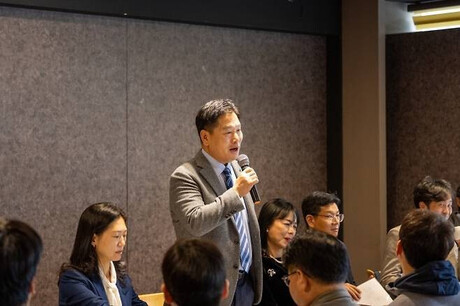
The ceremony was attended by key political and governmental figures, including Hyundai Rotem President and CEO Lee Yong-bae, Hyundai Transys President Baek Chul-seung, Hyundai Motor Vice President Lee Hang-su, South Chungcheong Province Governor Park Su-hyun, Seosan Mayor Lee Wan-seop, Acting ADD (Agency for Defense Development) Director Ko Deok-gon, Korea Aerospace Research Institute (KARI) Vice President Hwang Chang-jeon, Defense Acquisition Program Administration (DAPA) Business Support Division Director Lee Jong-joo, Agency for Defense Development & Technology Quality (DTaQ) Division Director Lee Yong-jin, and National Assembly member Sung Il-jong (Seosan-Taean, People Power Party).
Established in 1998 on a site spanning approximately 7,000 pyeong (approx. 23,140 square meters), the Seosan facility approaches its 30th anniversary. It is widely recognized as a foundational pillar for the aerospace industry as South Korea leaps into a private-sector-led "New Space" era.
Housing South Korea's first and only hypersonic and supersonic engine test facilities, the center has served as a comprehensive aerospace technology hub. It has developed testing infrastructure for propulsion systems ranging from the nation's first liquid-propellant rocket (KSR-III) to the Korea Space Launch Vehicle (KSLV-II), or Nuri.
While widely recognized for defense and railway businesses, Hyundai Rotem is also an aerospace foundational technology holder that has researched rocket propulsion systems and testing facilities for some 30 years. Since entering the rocket engine development sector in 1994, the company has accumulated core technologies spanning South Korea's first liquid-propellant rocket, Nuri, and next-generation reusable launch vehicles. In the aerospace sector, Hyundai Rotem maintains a strategic focus centered on next-generation engines and propulsion systems. In 2006, the company successfully conducted South Korea's first combustion test for a launch vehicle methane engine. Building on this achievement, it is fostering methane engine-based reusable launch vehicle businesses as a next-generation growth engine. Methane is considered a next-generation fuel adopted by global space companies due to its high economic efficiency and low soot production during combustion. SpaceX, the leader in the global market, uses methane-based Raptor engines for its next-generation ultra-large reusable launch vehicle, Starship.
Unlike Hanwha Aerospace, which focuses on launch vehicle system integration and kerosene engines, and Korea Aerospace Industries (KAI), which manufactures satellites and airframes, Hyundai Rotem is carving out a differentiated domain by focusing on next-generation propulsion systems. The company is also pursuing cooperation in reusable launch vehicle development by forming a consortium with Korean Air and KAI.
The newly completed second test building, alongside the existing first test building, will serve as a core research base for developing hypersonic engines, methane engines (35-ton and 10-ton classes) for reusable space launch vehicles, and major engine components. Hyundai Rotem explained that the interior is equipped with propulsion testing facilities capable of stable combustion tests for various aerospace engines, alongside performance test laboratories to evaluate the characteristics of individual components.
Hyundai Rotem is also accelerating its research and development on hypersonic engines. The hypersonic engines under study are categorized into solid scramjet engines and dual-mode ramjet (DMR) engines. Scramjet engines are equipped in missiles capable of flying at speeds five times the speed of sound or higher. They are characterized by advantages such as high-speed and long-distance flight, maneuverability maintenance, and secured terminal strike capability. DMR engines can transition between ramjet and scramjet modes depending on speed, enabling flight mode adjustments. They require more advanced technologies than solid scramjet engines.
Previously, in the ADD-led "HyCore" project for a Korean hypersonic vehicle, Hyundai Rotem was tasked with the design, manufacturing, and assembly of combustor assemblies, components for combustor operation, and auxiliary equipment—achieving performance that exceeded development target speeds. The company's scramjet engine technology was applied to this project.
"The Hyundai Rotem Seosan Aerospace Propulsion Testing Center is a crucible imbued with the blood, sweat, and tears of researchers dedicated to the localization of guided missile and launch vehicle engines over the past 30 years, as well as a space embodying Hyundai Motor Group's history toward national defense strength and space exploration," said Hyundai Rotem President and CEO Lee Yong-bae. "I am confident that the newly opened second test building will significantly contribute to South Korea's future national defense self-reliance and its leap into a space power."
Hyundai Rotem plans to continuously execute ongoing projects—including South Korean launch vehicle test facility construction and operation businesses, methane engine research and development projects, supersonic and hypersonic research and development projects, and defense guided-missile engine businesses—to advance its technologies and contribute to the progress of national defense science. In particular, the company aims to concentrate its capabilities to make next-generation aerospace engines one of the pillars of its future growth engines, leveraging internalized proprietary propulsion system technologies.
[Copyright (c) Global Economic Times. All Rights Reserved.]