• 2026.03.22 (Sun)
  • All articles
  • LOGIN
  • JOIN
Global Economic Times
fashionrunwayshow2026
  • Synthesis
  • World
  • Business
  • Industry
  • ICT
  • Distribution Economy
  • Well+Being
  • Travel
  • Eco-News
  • Education
  • Korean Wave News
  • Opinion
  • Arts&Culture
  • Sports
  • People & Life
    • International Student Report
    • With Ambassador
  • Column
    • Cho Kijo Column
    • Cherry Garden Story
    • Ko Yong-chul Column
    • Kim Seul-Ong Column
    • Lee Yeon-sil Column
  • Photo News
  • New Book Guide
MENU
 
Home > World

Trump Administration Pressures US Colleges with Federal Funding Pact

KO YONG-CHUL Reporter / Updated : 2025-10-02 19:33:54
  • -
  • +
  • Print


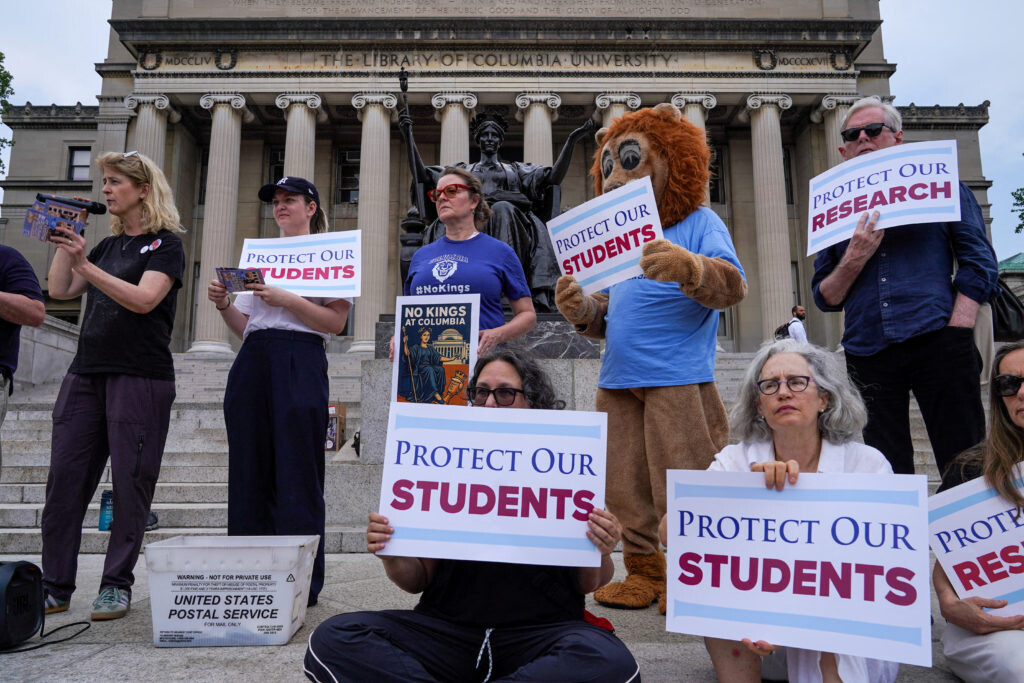
WASHINGTON, D.C. - The Trump administration has reportedly initiated a concerted effort to reshape the political and academic landscape of American higher education, leveraging federal funding as a powerful tool to pressure colleges into accepting a broad set of demands. The strategy involves asking universities to sign an "Agreement for Academic Excellence in Higher Education" in exchange for potentially substantial federal aid and other benefits.

According to the Wall Street Journal, the administration sent letters to a preliminary group of institutions, including Ivy League schools like Dartmouth, the University of Pennsylvania, Brown University, and the Massachusetts Institute of Technology (MIT), outlining the terms of the ten-point pact. The agreement presents a stark choice: adopt the government’s prescribed policies or risk the loss of crucial federal support.

Mandates Target Admissions, Enrollment, and Campus Climate 

The proposed pact contains several highly contentious provisions that directly challenge established university practices and norms. Key requirements include:

Foreign Student Cap: Limiting the enrollment of international undergraduate students to 15% of the total student body. This measure, if widely adopted, could significantly impact students from countries like South Korea, which sends a large number of undergraduates to the US.
Admissions and Hiring: Prohibiting the consideration of race or gender in admissions and employment processes. This runs contrary to many diversity, equity, and inclusion (DEI) initiatives currently in place at US universities.
Standardized Testing: Mandating the submission of scores from the SAT or similar entrance exams, reversing a trend where many institutions have made these tests optional or eliminated them entirely.
Tuition Freeze: Committing to a five-year tuition freeze.
 

Focus on Political Atmosphere and Autonomy 

Beyond admissions and finance, many of the demands center on the political climate within universities, aiming to create an environment more favorable to conservative viewpoints. These provisions include eliminating academic departments that the administration deems to belittle conservative thought.

The letters reportedly warn that while universities are free to pursue their own values if they forgo federal benefits, institutions heavily reliant on government support could face significant pressure. This is seen by critics as a direct warning of potential penalties for non-compliance.

Higher Education Leaders Push Back 

The initiative has drawn immediate and fierce opposition from major figures in the higher education community. Ted Mitchell, president of the American Council on Education (ACE), which represents over 1,500 college presidents, strongly criticized the proposal's underlying premise, particularly concerning political expression and viewpoint.

"The federal government shouldn't be stepping in and sorting this out," Mitchell stated, raising concerns about the detrimental effect on freedom of expression.

This new approach follows earlier reports of the Trump administration's plans to reform research funding rules to favor universities cooperating with government policies, such as eliminating diversity programs. Analysts view the new pact as a dramatic escalation—a comprehensive, nationwide attempt to assert federal control over the fundamental academic and administrative policies of US universities, moving beyond previous, targeted actions against individual institutions. The ultimate outcome of this political maneuvering is expected to have lasting consequences for the autonomy of American colleges and the future of international education in the United States.

[Copyright (c) Global Economic Times. All Rights Reserved.]

  • #globaleconomictimes
  • #micorea
  • #mykorea
  • #Lifeplaza
  • #nammidonganews
  • #singaporenewsk
  • #Samsung
  • #Daewoo
  • #Hyosung
  • #A
KO YONG-CHUL Reporter
Reporter Page

Popular articles

  • Ko Sang-goo, President of World Federation of Korean Associations, Elected as First Private Sector Chair of World Korean Community Leaders Convention

  • Revised and Expanded Edition of ‘Failure of Negotiations with North Korea: Truth and Solutions’ Published

  • Commentary That Douses the Joy of Victory: A Twisted Perspective

I like it
Share
  • Facebook
  • X
  • Kakaotalk
  • LINE
  • BAND
  • NAVER
  • https://www.globaleconomictimes.kr/article/1065609105571760 Copy URL copied.
Comments >

Comments 0

Weekly Hot Issue

  • Coway Clinches Top Honor at "Water Taste Awards" for 7th Consecutive Year
  • HP Targets Korea as Strategic Hub for 'Edge AI' Expansion, Seeking Startup Partnerships
  • Pearl Abyss’s 'Crimson Desert' Shatters Records with 2 Million Copies Sold on Day One
  • "BTS Over Books?" Indian Academies Issue Emergency Notices as Students Plot Mass Absences for Comeback Live
  • Naver to Shut Down Men's Fashion Service 'MR.' to Launch Expanded AI-Driven Fashion Platform
  • JBNU and SKKU Researchers Achieve Breakthrough in "Dream Material" MXene, Setting New World Records in Performance

Most Viewed

1
An Open Letter to BTS On the Eve of a Historic Performance
2
From Industrial Capital to Tourism Mecca... Ulsan Makes a Bold Move with ‘Experiential Content’ in 2026
3
Ko Sang-goo, President of World Federation of Korean Associations, Elected as First Private Sector Chair of World Korean Community Leaders Convention
4
It is Time for BTS’s Fandom, ARMY, to Step Forward
5
Korean Stock Market Plunges: Circuit Breaker and Sidecar Triggered Amid Geopolitical Crisis
광고문의
임시1
임시3
임시2

Hot Issue

Vishay Unveils Ultra-Compact 0404 RGB LED with Independent Chip Control for Enhanced Color Precision

Coway Clinches Top Honor at "Water Taste Awards" for 7th Consecutive Year

AI Medical Ecosystem in Focus: KIMES 2026 Opens in Seoul as Global Healthcare Hub

Netanyahu Declares Decisive Blow to Iran’s Nuclear and Missile Programs, Signals Early End to War

Let’s recycle the old blankets in Jeju Island’s closet instead of incinerating them.

Global Economic Times
korocamia@naver.com
CEO : LEE YEON-SIL
Publisher : KO YONG-CHUL
Registration number : Seoul, A55681
Registration Date : 2024-10-24
Youth Protection Manager: KO YONG-CHUL
Singapore Headquarters
5A Woodlands Road #11-34 The Tennery. S'677728
Korean Branch
Phone : +82(0)10 4724 5264
#304, 6 Nonhyeon-ro 111-gil, Gangnam-gu, Seoul
Copyright © Global Economic Times All Rights Reserved
  • 에이펙2025
  • APEC2025가이드북TV
  • 독도는우리땅
Search
Category
  • All articles
  • Synthesis
  • World
  • Business
  • Industry
  • ICT
  • Distribution Economy
  • Well+Being
  • Travel
  • Eco-News
  • Education
  • Korean Wave News
  • Opinion
  • Arts&Culture
  • Sports
  • People & Life 
    • 전체
    • International Student Report
    • With Ambassador
  • Column 
    • 전체
    • Cho Kijo Column
    • Cherry Garden Story
    • Ko Yong-chul Column
    • Kim Seul-Ong Column
    • Lee Yeon-sil Column
  • Photo News
  • New Book Guide
  • Multicultural News
  • Jobs & Workers