![[등록] 2026-09-01 15:48:31](/support/_updata/banner2/tl181982910_6749.png)


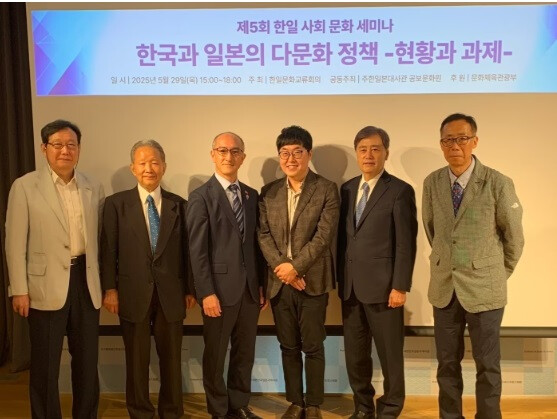
SEOUL, South Korea – On May 29, the Public and Cultural Affairs Department of the Embassy of Japan in Korea, in collaboration with the Korea-Japan Cultural Exchange Council, successfully co-hosted the "5th Korea-Japan Social and Cultural Seminar." The event, held on the eve of May 30, served as a crucial platform for experts from both nations to critically assess the current state and challenges of multicultural policies in Korea and Japan.
A Confluence of Expertise on Multiculturalism
Under the central theme of "Current Status and Challenges of Multicultural Policies in Korea and Japan," the seminar brought together leading scholars and policy experts from both countries. The discussions delved into a wide array of social issues pertinent to multiculturalism, alongside the evolving landscape of cultural and human exchange between the two East Asian neighbors. This timely discourse comes as both Korea and Japan grapple with rapidly aging populations and declining birth rates, compelling them to consider immigration as a vital component of future economic and social stability.
Representing the Republic of Korea, Professor Lee Yun-seok of Keimyung University's Department of Public Administration delivered a compelling presentation titled "Korea's Multicultural Policy and the Issue of Accepting Immigrants." Professor Lee's address shed light on the intricacies of Korea's approach to multiculturalism, which has historically focused on supporting marriage migrants and their families. He highlighted the government's efforts to integrate these communities into society through various support programs, including language education, cultural adaptation courses, and welfare services. However, Professor Lee also critically examined the challenges faced by Korea, such as the need for more comprehensive policies to accommodate diverse immigrant groups beyond marriage migrants, address issues of discrimination, and ensure equitable access to education and employment opportunities. He underscored the importance of shifting from a "homogeneous nation" narrative to one that embraces diversity as a strength, particularly as the demand for foreign labor in industries like manufacturing, agriculture, and caregiving continues to rise.
On the Japanese side, Visiting Professor Toshihiro Menju of Kansai International University presented on "Japan's Multicultural Coexistence Strategy and JICA's Policy on Accepting Foreign Human Resources." Professor Menju offered a nuanced perspective on Japan's evolving stance toward multiculturalism. Historically, Japan has maintained a more cautious approach to immigration compared to many Western nations, prioritizing ethnic homogeneity. However, faced with severe labor shortages and an aging society, the Japanese government has gradually begun to relax its immigration policies, particularly through programs aimed at attracting skilled foreign workers and technical trainees. Professor Menju detailed how the Japan International Cooperation Agency (JICA) plays a pivotal role in facilitating the acceptance of foreign talent, especially from developing countries, often through technical intern training programs. He emphasized Japan's shift from a purely economic rationale for immigration to one that increasingly considers the social aspects of integration and "multicultural coexistence" (tabunka kyosei). This includes initiatives to provide support for foreign residents in areas such as education for their children, healthcare access, and community integration, albeit with varying degrees of success and ongoing challenges in fully achieving genuine coexistence.
A Meaningful Dialogue on the Road to Bilateral Cooperation
Professor Kim Young-geun of Korea University's Global Japan Research Institute, who moderated the seminar's discussion, provided a poignant evaluation of the proceedings. He remarked, "As we celebrate the 60th anniversary of the normalization of diplomatic relations between Korea and Japan this year, this seminar offered a highly meaningful discussion that examined the current status of multicultural coexistence, especially immigration policies, as a potential agenda and policy model for cooperation between our two nations."
Professor Kim's statement underscores the growing recognition in both Korea and Japan that managing diverse populations is not merely an internal matter but an area ripe for bilateral learning and collaboration. Despite historical complexities, both countries share similar demographic trajectories and are grappling with the social, economic, and cultural implications of becoming more diverse societies. The seminar provided a unique opportunity for experts to exchange best practices, identify common pitfalls, and explore pathways for future cooperation in developing more inclusive and effective multicultural policies. This could involve sharing research on immigrant integration, coordinating efforts to combat discrimination, and developing joint programs for cultural exchange that foster mutual understanding and respect among diverse communities within both nations.
The dialogue highlighted that while Korea and Japan have adopted different approaches to multiculturalism, both are on a journey of adaptation and re-evaluation. The seminar served as a testament to the ongoing commitment of both countries to engage in constructive dialogue on critical social issues, paving the way for a future where multicultural coexistence is not just a policy goal but a lived reality.
[Copyright (c) Global Economic Times. All Rights Reserved.]