• 2026.03.22 (Sun)
  • All articles
  • LOGIN
  • JOIN
Global Economic Times
fashionrunwayshow2026
  • Synthesis
  • World
  • Business
  • Industry
  • ICT
  • Distribution Economy
  • Well+Being
  • Travel
  • Eco-News
  • Education
  • Korean Wave News
  • Opinion
  • Arts&Culture
  • Sports
  • People & Life
    • International Student Report
    • With Ambassador
  • Column
    • Cho Kijo Column
    • Cherry Garden Story
    • Ko Yong-chul Column
    • Kim Seul-Ong Column
    • Lee Yeon-sil Column
  • Photo News
  • New Book Guide
MENU
 
Home > Synthesis

Argentina's Waterlogged Farmlands Get a 'Drought' Reprieve: Hope Rises as Dry Weather Forecast Offers Relief Amid Delayed Soybean Planting

Global Economic Times Reporter / Updated : 2025-05-22 19:51:54
  • -
  • +
  • Print

Buenos Aires, Argentina – The Buenos Aires Grains Exchange announced that Argentina's muddy farmlands are set to benefit from dry weather in the coming days. This welcome news comes amidst an urgent situation for the country's soybean crops, which have already been delayed by recent intense storms. Argentina is the world's largest exporter of soybean oil and soy meal, and soybean yields have a significant impact on the national economy.

Late last week, the northern region of Buenos Aires province was battered by fierce winds and heavy rain, causing considerable damage. The grains exchange had previously warned that it might have to lower its soybean harvest estimates due to this heavy rainfall.

 
Argentina's Grain Production Status and Economic Importance

Argentina is one of the world's top three agricultural exporters, with soybeans, corn, and wheat being its main cultivated crops. Soybeans, in particular, are the core of Argentina's agriculture and a vital pillar of its national economy. Soybeans are primarily processed into soybean oil and soy meal, which is used as animal feed, and then exported globally, accounting for a significant portion of Argentina's foreign currency earnings. Therefore, soybean yields directly impact Argentina's economic growth rate, inflation, and trade balance.

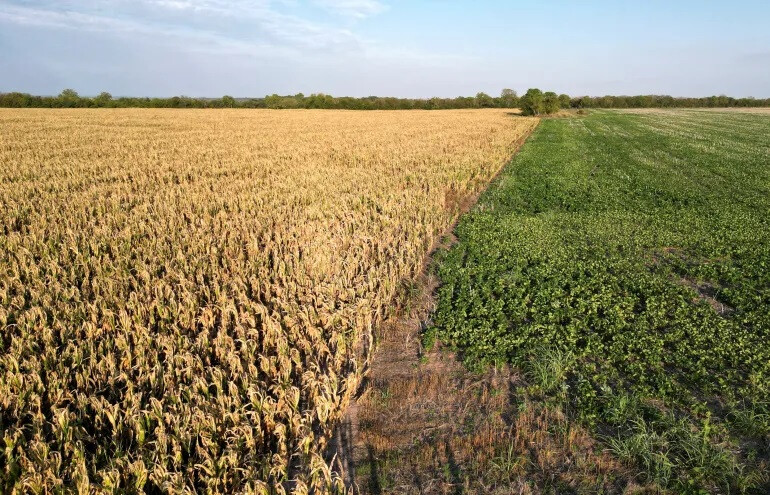
The damage caused by this recent heavy rainfall has raised concerns about reduced yields due to delayed soybean planting and adverse effects on crop growth. If farmlands are submerged, seeds can rot or fail to germinate properly, and existing crops may die due to difficulty in root respiration. Furthermore, as the soil turns muddy, it becomes difficult for agricultural machinery to access the fields, leading to problems in performing farming operations at the appropriate time.

 
Recurring Adverse Weather and Agricultural Challenges

In recent years, Argentina has faced difficulties in agricultural production due to extreme weather phenomena, alternating between droughts and floods. With the increasing frequency of unpredictable weather events influenced by climate change, farmers experience annual anxiety about crop fluctuations. In particular, climate patterns like La Niña and El Niño significantly impact Argentina's rainfall, directly affecting grain production.

Last year, a record-breaking drought led to a substantial reduction in soybean and corn production, severely impacting the Argentine economy. While the recent heavy rainfall presented another challenge for farmers, the upcoming forecast of dry weather offers some hope.

 
Future Outlook and Response

The Buenos Aires Grains Exchange anticipates that the continued dry weather over the next few days will dry out the submerged farmlands, which should positively affect soybean crop conditions. However, it is unlikely that the damage already incurred will be fully recovered. Experts emphasize that the Argentine government and agricultural stakeholders must devise long-term strategies for climate change adaptation, focusing on developing disaster-resistant crop varieties and improving infrastructure, such as expanding irrigation facilities. Additionally, it is crucial to strengthen agricultural insurance schemes to minimize farmers' losses and to enhance meteorological information systems to enable farmers to plan their operations with more accurate information.

Argentina's agriculture is not merely about food production; it is directly linked to the nation's economic survival. Therefore, continuous efforts and investments are critically needed for stable agricultural production.

[Copyright (c) Global Economic Times. All Rights Reserved.]

  • #NATO
  • #OTAN
  • #OECD
  • #G20
  • #globaleconomictimes
  • #Korea
  • #UNPEACEKOR
  • #micorea
  • #mykorea
  • #newsk
  • #UN
  • #UNESCO
  • #nammidongane
Global Economic Times Reporter
Reporter Page

Popular articles

  • From Industrial Capital to Tourism Mecca... Ulsan Makes a Bold Move with ‘Experiential Content’ in 2026

  • A New Milestone for Ukraine’s Post-War Reconstruction: The Birth of ISVP

  • About mexican food 

I like it
Share
  • Facebook
  • X
  • Kakaotalk
  • LINE
  • BAND
  • NAVER
  • https://www.globaleconomictimes.kr/article/1065610274722650 Copy URL copied.
Comments >

Comments 0

Weekly Hot Issue

  • Coway Clinches Top Honor at "Water Taste Awards" for 7th Consecutive Year
  • HP Targets Korea as Strategic Hub for 'Edge AI' Expansion, Seeking Startup Partnerships
  • Pearl Abyss’s 'Crimson Desert' Shatters Records with 2 Million Copies Sold on Day One
  • "BTS Over Books?" Indian Academies Issue Emergency Notices as Students Plot Mass Absences for Comeback Live
  • Naver to Shut Down Men's Fashion Service 'MR.' to Launch Expanded AI-Driven Fashion Platform
  • JBNU and SKKU Researchers Achieve Breakthrough in "Dream Material" MXene, Setting New World Records in Performance

Most Viewed

1
An Open Letter to BTS On the Eve of a Historic Performance
2
From Industrial Capital to Tourism Mecca... Ulsan Makes a Bold Move with ‘Experiential Content’ in 2026
3
Ko Sang-goo, President of World Federation of Korean Associations, Elected as First Private Sector Chair of World Korean Community Leaders Convention
4
It is Time for BTS’s Fandom, ARMY, to Step Forward
5
Korean Stock Market Plunges: Circuit Breaker and Sidecar Triggered Amid Geopolitical Crisis
광고문의
임시1
임시3
임시2

Hot Issue

Vishay Unveils Ultra-Compact 0404 RGB LED with Independent Chip Control for Enhanced Color Precision

Coway Clinches Top Honor at "Water Taste Awards" for 7th Consecutive Year

AI Medical Ecosystem in Focus: KIMES 2026 Opens in Seoul as Global Healthcare Hub

Netanyahu Declares Decisive Blow to Iran’s Nuclear and Missile Programs, Signals Early End to War

Let’s recycle the old blankets in Jeju Island’s closet instead of incinerating them.

Global Economic Times
korocamia@naver.com
CEO : LEE YEON-SIL
Publisher : KO YONG-CHUL
Registration number : Seoul, A55681
Registration Date : 2024-10-24
Youth Protection Manager: KO YONG-CHUL
Singapore Headquarters
5A Woodlands Road #11-34 The Tennery. S'677728
Korean Branch
Phone : +82(0)10 4724 5264
#304, 6 Nonhyeon-ro 111-gil, Gangnam-gu, Seoul
Copyright © Global Economic Times All Rights Reserved
  • 에이펙2025
  • APEC2025가이드북TV
  • 독도는우리땅
Search
Category
  • All articles
  • Synthesis
  • World
  • Business
  • Industry
  • ICT
  • Distribution Economy
  • Well+Being
  • Travel
  • Eco-News
  • Education
  • Korean Wave News
  • Opinion
  • Arts&Culture
  • Sports
  • People & Life 
    • 전체
    • International Student Report
    • With Ambassador
  • Column 
    • 전체
    • Cho Kijo Column
    • Cherry Garden Story
    • Ko Yong-chul Column
    • Kim Seul-Ong Column
    • Lee Yeon-sil Column
  • Photo News
  • New Book Guide
  • Multicultural News
  • Jobs & Workers