![[등록] 2026-09-01 15:48:31](/support/_updata/banner2/tl181982910_6749.png)


(C) Table.Briefings
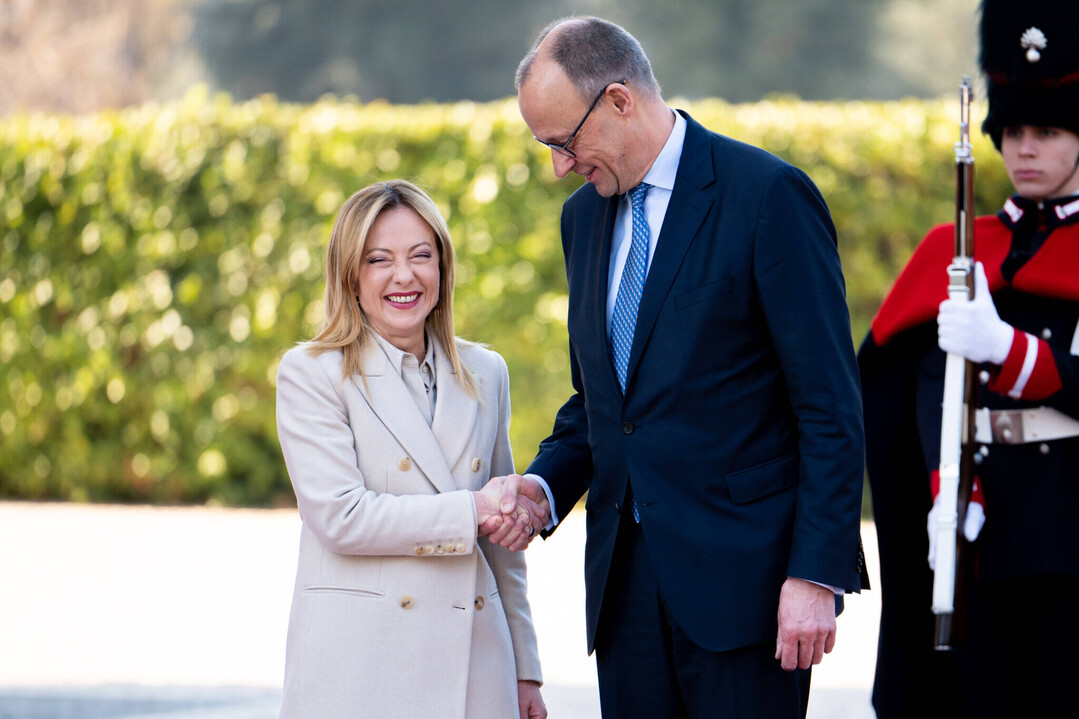
ROME – In a move that has sent ripples through the corridors of power in Brussels and Paris, German Chancellor Friedrich Merz and Italian Prime Minister Giorgia Meloni met in Rome on Friday to solidify a significant upgrade in bilateral relations. The summit, marked by agreements on defense manufacturing and regular joint military exercises, has ignited a debate over whether Berlin is pivoting away from its historical "special relationship" with France in favor of a rising Italy.
A New Strategic Partnership
The discussions centered on deep industrial and security cooperation. The two leaders agreed to integrate their defense industries more closely, particularly in the production of advanced weaponry. Beyond hardware, the commitment to institutionalized joint military drills signals a level of trust and operational synchronization rarely seen outside the core Franco-German "engine" of Europe.
"Germany’s foreign relations do not operate on a hierarchy," Chancellor Merz stated during a joint press conference, seeking to downplay suggestions that Italy was being promoted at the expense of France. "We welcome close, cooperative ties with all our partners, including France and Italy alike. We operate together within the framework of the European Union."
The Shadow of the Élysée
Despite Merz’s reassurances, the historical context makes this shift impossible to ignore. Since the 1963 Élysée Treaty, the Franco-German partnership—forged by Konrad Adenauer and Charles de Gaulle—has been the bedrock of European integration. As the EU’s two largest economies, their alignment has dictated the continent's direction for over six decades.
However, the current political landscape in Paris is one of paralysis. President Emmanuel Macron, recently seen in public wearing sunglasses due to a ruptured blood vessel in his eye—a physical manifestation, perhaps, of the immense stress of his office—is grappling with a fractured, "hung" parliament. As of late January 2026, France has yet to pass its annual budget, a delay that threatens the stability of the Eurozone. With only 16 months left in his term, Macron is increasingly viewed as a "lame duck" leader, unable to project the domestic strength required for European leadership.
The Meloni-Merz Ideological Synergy
Analysts point to an undeniable ideological chemistry between Merz and Meloni that is missing in the Merz-Macron dynamic.
Friedrich Merz: A staunch conservative representing the CDU/CSU alliance.
Giorgia Meloni: A leader whose "strong conservative" stance has brought unprecedented political stability to Rome since 2022.
While Macron’s centrist philosophy often clashes with Merz’s traditional conservatism, Meloni and Merz find common ground on issues of fiscal discipline, border security, and a pragmatic approach to industrial sovereignty. With Meloni’s coalition expected to win the 2027 elections comfortably, she offers Berlin something Paris currently cannot: predictability.
Economic Realities and the "Sick Man" Label
The economic divergence between France and Italy is further fueling this diplomatic realignment. While France struggles with legislative gridlock and fiscal uncertainty, Italy has maintained a surprisingly steady economic course under Meloni.
"There is a growing perception in Berlin that the 'Franco-German motor' is currently idling," says an EU diplomatic source. "If Germany wants to move forward on defense integration or energy security, it needs a partner that can actually deliver. Right now, that partner is Italy."
Conclusion: A Balancing Act
Chancellor Merz remains adamant that Germany is not "abandoning" France. However, the optics of the Rome summit suggest a pragmatic broadening of Germany’s European strategy. By elevating Italy to a primary security and economic partner, Merz is not just hedging his bets against French instability; he is acknowledging a new reality where the Mediterranean power is no longer a junior partner, but a central pillar of the European project.
As the 2026 fiscal year begins with uncertainty in Paris, the handshake in Rome may well be remembered as the moment the "dual engine" of Europe became a triad—or perhaps, the moment the axis finally shifted South.
[Copyright (c) Global Economic Times. All Rights Reserved.]