

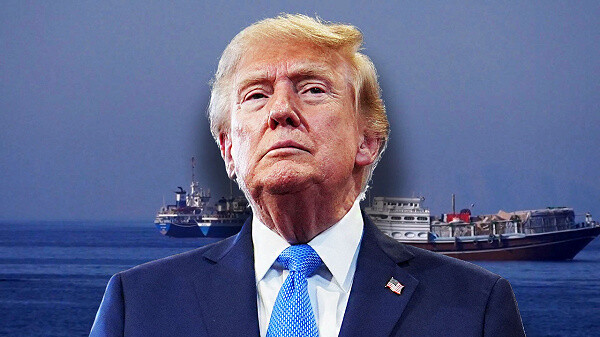
GARDEN CITY, NEW YORK — U.S. President Donald Trump escalated the ongoing maritime crisis in the Middle East on Friday, declaring that he intends to designate the strategic Strait of Hormuz as “territory of the United States.” The inflammatory remarks, delivered during a rally in Garden City, New York, have drawn a sharp and immediate rebuke from Tehran, further deepening the deadlock that has paralyzed global energy shipping for months.
A High-Stakes War of Words
President Trump’s statement follows a series of recent assertions that the U.S. military has achieved “total control” over the critical waterway. “Pretty soon, I’ll be declaring the Hormuz Strait a territory of the United States,” Trump told a crowd of supporters. He characterized the move as a natural outcome of the U.S.-led blockade of the region, framing the rising domestic fuel costs as a necessary sacrifice to prevent a hostile regime from acquiring nuclear capabilities.
Tehran responded with characteristic defiance. Kazem Gharibabadi, Iran’s Deputy Foreign Minister for Legal and International Affairs, took to X (formerly Twitter) to dismiss the U.S. President’s comments as “fanciful delusions.”
“The Strait of Hormuz cannot be seized by tweet, nor by aircraft carrier, nor by issuing an order, nor by an election speech,” Gharibabadi wrote. He emphasized that the waterway “has been Iranian, is Iranian, and will remain Iranian,” asserting that the strait will only open or close under Tehran’s command.
Maritime Traffic at a Standstill
The war of words underscores a brutal reality for international trade: the Strait of Hormuz, a vital artery for the world’s energy supply, remains effectively closed. According to recent data, transit volumes have plummeted to a mere fraction of pre-conflict levels. Reports from the United Kingdom Maritime Trade Operations (UKMTO) indicate that shipping traffic remains significantly below normal, with many merchant vessels avoiding the area due to the extreme risk of kinetic military action.
The human and financial toll continues to mount. Marine insurers estimate that the ongoing conflict has generated between $1.5 billion and $2 billion in claims from approximately 70 casualties since the hostilities began in late February 2026. Furthermore, container trade volumes through the Middle East Gulf have suffered significant losses, with regional imports and exports seeing double-digit declines.
Escalation Amid Diplomatic Silence
The situation on the ground remains volatile. On Friday, the Abu Dhabi National Oil Company (ADNOC) reported that yet another one of its vessels was attacked while transiting the strait. While no casualties were reported, the incident is the latest in a string of attacks that have turned the waterway into one of the most dangerous maritime zones in the world.
Diplomatic efforts to resolve the impasse appear stalled. Iranian Foreign Minister Abbas Araghchi clarified on Saturday that, despite messages being exchanged via intermediaries like Qatar and Pakistan, there are no official negotiations taking place with Washington. Tehran maintains that any reopening of the strait is strictly conditional on the U.S. meeting its extensive list of demands, including the release of frozen assets and an end to military operations across the region.
A Global Energy Bottleneck
As the U.S. maintains its naval blockade of Iranian ports and Iran continues to deploy mines and drones against transiting tankers, the global energy market is bracing for a prolonged disruption. While some non-Iranian-linked traffic has managed to persist, the overall environment remains highly insecure.
With the U.S. midterm elections approaching, the issue of stable fuel prices—directly linked to the situation in the Gulf—has become a central pillar of the political discourse. However, as President Trump pushes for a policy of maximum pressure and Iran digs in, the prospect of a peaceful resolution to the Hormuz crisis remains, for now, a distant hope.
[Copyright (c) Global Economic Times. All Rights Reserved.]