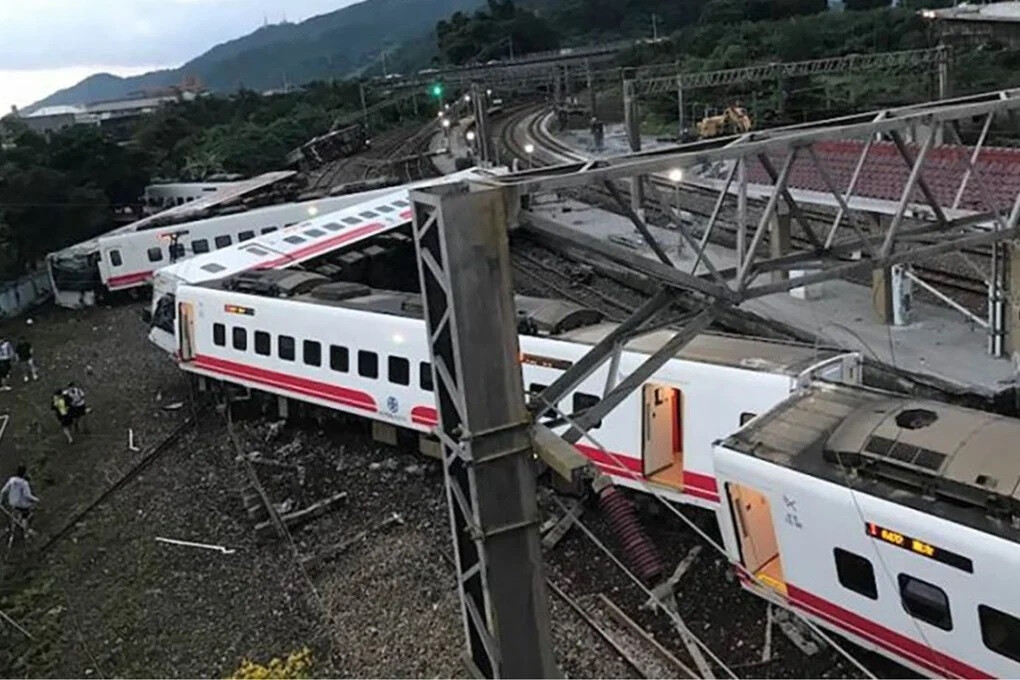
October 21, 2018. The Taiwan Railways Administration (TRA) Puyuma Express No. 6432, passing near Xinma Station in Yilan County, Taiwan, derailed and overturned due to speeding. Out of 366 people on board, including 3 crew members, 18 people died and 267 were injured. It is recorded as one of the worst disasters in Taiwan’s railway history. Train No. 6432 derailed while passing through the curved section in front of the Xinma Station platform at around 4:49 PM that day. All 8 cars that went off the tracks overturned, severely damaging various parts of the cars, and passengers were trapped inside the entangled carriages.
Most of the fatalities came from Car No. 8, the frontmost train. The carriage was severely crushed into a "W" shape during the overturning process, resulting in heavy casualties. Of the 18 fatalities, 15 died at the scene, and 6 of them were found inside Car No. 8. All casualties were confirmed to be Taiwanese, except for one injured American.
A woman riding in Car No. 2 at the time of the accident shared the situation, saying, "Right before the accident, the train suddenly sped up and shook violently." Another passenger said, "A considerable number of passengers were sleeping, so they couldn't respond in time."
Knowing the train had problems, it departed anyway… Control center unaware that safety device was turned off
The accident train was a Puyuma Express, a high-speed train with a maximum speed of 150 km/h manufactured by Nippon Sharyo, a subsidiary of Japan's JR Tokai. The TRA had deployed this train starting in 2013 on routes connecting Taipei, Yilan, Hualien, and other eastern regions.
The accident train was about 6 years old, in good condition, and had undergone inspection in 2017. The train departed Shulin Station for Taitung at 2:50 PM that day. Train abnormalities had been reported even before the accident, but it departed anyway, and about 50 minutes later, a problem occurred in the main air compressor (compressor), a core component of the train, disrupting the power supply to the train.
The engineer continuously appealed train abnormalities, saying, "The train lacks power" and "The pressure is low," and requested maintenance support. Due to the defect, the train struggled to gain proper speed and experienced difficulties in normal operation, arriving at Yilan Station about 15 minutes late.
After receiving temporary measures at the station, operation resumed, but the root cause of the breakdown remained unresolved. Even after departing Yilan Station, warnings related to power shortages continued. As operational disruptions occurred because of this, the engineer turned off the ATP (Automatic Train Protection), a core safety device that automatically limits train speed by detecting speeding, in the process of controlling a malfunctioning device.
When the engineer disabled the ATP, a warning signal should have gone to the control center, but due to incorrect wiring design by the train manufacturer, no warning signal sounded at the control center at the time. At the time, the engineer was exchanging radio calls with the control room to solve the problem, and around 4:46 PM, about 3 minutes before the accident, the control room decided to replace it with another train at Hualien Station.
The engineer, who had to make up for the 15-minute delay amidst the problem situation and continue operating to Hualien Station, failed to slow down at the Xinma Station sharp curve section, ultimately leading to the accident.
3 seconds before derailment, brakes failed… Frontmost car crushed
The accident site near Xinma Station was a sharp curve section with a curve radius of only about 300 meters. The speed limit here was 75 km/h, but at the time of the accident, the train was running at 141 km/h—about twice the speed limit.
The engineer applied the emergency brake a mere 3 seconds before derailing. However, the train had already entered the sharp curve section at high speed and was in an uncontrollable state. Turning the curve at high speed, the train failed to overcome centrifugal force, derailing and overturning.
The frontmost Car No. 8 crashed into the platform wall nearby and was crushed. The accident, which happened in a short moment, led to massive casualties. In this accident, the engineer suffered bruises and lacerations to his head and chest. After receiving treatment at the hospital, he was handed over to the prosecution the next day, October 22, with his head wrapped in bandages and in a wheelchair, undergoing 12-hour intensive questioning.
Taiwanese prosecutors requested an arrest warrant for the engineer on charges of professional negligence resulting in death. However, the court dismissed it and ordered his release on bail of 500,000 New Taiwan dollars (approx. 20 million KRW) under conditions restricting communication and residence. After paying the bail, the engineer stood trial without detention.
Engineer appealed unfairness… "Neglect of forward view and speeding are the causes of the accident," prison sentence confirmed
During the trial, the engineer appealed his unfairness, stating, "I continuously reported train breakdowns to my superiors, and vehicle defects and the railway authority's poor maintenance culture were the root causes of the accident." He also claimed, "There was a power abnormality in the train, and the scale on the speedometer did not match the actual train speed," adding, "The speedometer showed 82-83 km/h, so I didn't know I was running at 140 km/h."
However, black box analysis by Taiwanese prosecutors and government investigators revealed that the speedometer had functioned normally. As the Taiwan Transportation Safety Board (TTSB) thoroughly analyzed the train's black box (TCMS - Train Control and Monitoring System), the speeds recorded in the engineer's digital cab speedometer and the black box matched.
The court judged that even if the speedometer had broken down as the engineer claimed, he would have been able to sufficiently recognize the speeding state through the train's vibration, noise, and scenery outside the window. Black box records also worked unfavorably for the engineer.
Until just before the accident, the engineer maintained the power lever, which controls the train's output, at the highest stage. The fact that no measures for deceleration were taken right before entering the sharp curve became a major basis for the guilty judgment. The court acknowledged, "Circumstances where the engineer suffered extreme stress while operating due to some parts failure of the train and design mistakes by the train manufacturer are recognized."
However, it ruled, "Turning off the ATP arbitrarily without permission from the control room, neglecting the most basic duty of looking forward as an engineer responsible for passenger safety, and speeding at twice the speed limit were the direct causes of the accident," sentencing him to 4 years and 6 months in prison.
Two managers, including the former director of the Taiwan Railways Administration who neglected remote warning system testing when the train was introduced, were also indicted together, but they were acquitted. Although the engineer appealed and final-appealed, the Taiwan Supreme Court dismissed the engineer's final appeal in March 2023, finalizing the original verdict and concluding the criminal trial against the engineer about 4 years and 5 months after the accident. The engineer was released on parole last July, approximately 3 years and 4 months since the finalized verdict. Under Taiwan law, parole can be applied for after serving more than half of the prison sentence and living a model prison life.
[Copyright (c) Global Economic Times. All Rights Reserved.]