


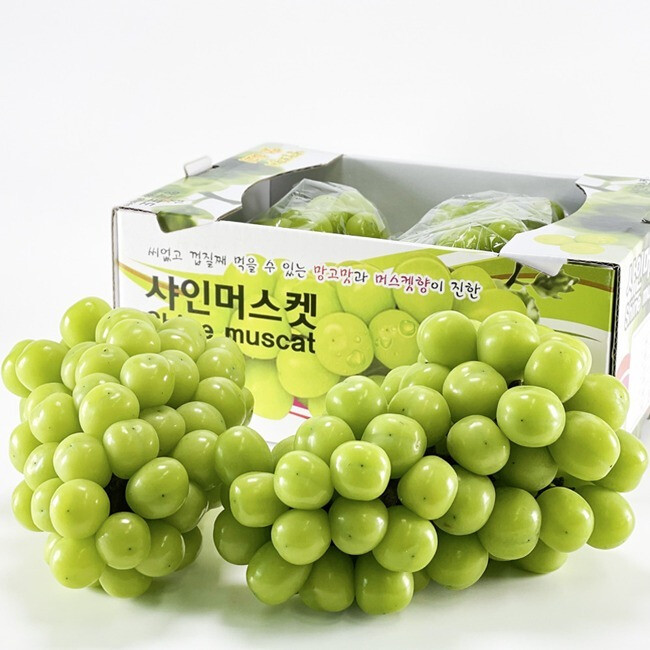
South Korea’s fresh grape exports have surpassed $100 million for the first time in history for a single agricultural product. This milestone was achieved by aggressively carving out overseas markets as Shine Muscat—once a wildly popular premium fruit—faced domestic oversupply and falling prices. By expanding exports, domestic shipping volumes have been distributed, helping to ease price depression burdens for local farmers.
According to the Ministry of Agriculture, Food and Rural Affairs (MAFRA) on the 16th, cumulative grape exports crossed the $100 million threshold based on performance through the second week of November. Cumulative exports through the end of last month reached $90.65 million, representing an 85.2% increase compared to the same period last year. In October alone, when grape shipments hit full swing, exports reached $34.80 million—2.7 times the figure from the same month last year. During a commemorative shipping ceremony in Sangju, North Gyeongsang Province, Agriculture Minister Song Mi-ryung stated, "We have achieved $100 million in exports for a single fresh agricultural product for the very first time, setting a historic new milestone in agricultural history."
South Korea’s grape trade balance also recorded a surplus for the first time. Following the implementation of the South Korea-Chile Free Trade Agreement (FTA) in 2004, domestic grapes faced fierce competition from relatively cheaper imports. As recently as 2016, grape imports stood at $145.01 million—28 times higher than exports ($5.12 million). However, from January to October of this year, export values outpaced imports ($64.13 million) over the same period, yielding a trade surplus of $26.52 million. This demonstrates that a sector once feared to be devastated by market opening has shown new growth potential abroad after 22 years.
The export surge was largely driven by Taiwan and the United States. Between January and October of this year, exports to Taiwan skyrocketed by 114.5% year-on-year to $51.30 million, accounting for over half of total exports. Exports to the U.S. also surged by 177.6% to $16.44 million, while shipments to Hong Kong and Vietnam grew by 24.4% and 17.4%, respectively.
Shine Muscat, which accounted for the vast majority of these export volumes, gained massive popularity in South Korea starting in the late 2010s. Often dubbed the "mango grape" due to being seedless, edible with the skin on, and exceptionally high in sugar content, it commanded higher prices than regular grapes and emerged as a lucrative cash crop for farmers. Enticed by high profitability, farmers rushed into cultivation, rapidly expanding production infrastructure. According to the Korea Rural Economic Institute, the cultivation area for Shine Muscat expanded more than twofold from 2,913 hectares in 2020 to 6,307 hectares in 2024.
However, this cultivation boom led directly to oversupply. With insufficiently skilled farmers entering the market and lower-quality grapes entering circulation, consumer dissatisfaction regarding quality began to grow. Shine Muscat, once reliably sold at premium prices, gradually fell out of favor.
Consequently, prices plummeted. According to the Korea Agro-Fisheries & Food Trade Corporation (aT), the average consumer price for 2 kilograms of Shine Muscat stood at 11,791 won as of the 1st of last month—a drop of about 71% compared to five years ago. As profitability deteriorated, cultivation areas shifted into a downward trend starting last year. With the domestic market saturated, securing overseas distribution channels became critical, though quarantine and quality standards posed significant hurdles.
This year, the production and distribution processes were jointly prepared by the public and private sectors. Farmers and businesses established stable supply foundations, while the government backed them up with quarantine and logistics support. Since early this year, MAFRA collaborated with integrated organizations comprising producer groups and export companies to secure export volumes.
Efforts were also made to lower trade barriers tailored to each country. In Taiwan, its largest market, residual pesticide safety was managed right from the production stage through a pre-registration system. In the U.S., export foundations were streamlined to meet local quarantine standards, expanding U.S.-bound quarantine complexes from 31 to 41 locations.
Exporters tailored their sales strategies to match the characteristics of foreign consumers. In Taiwan, they concentrated on the gift-fruit market, whereas in the U.S., they expanded consumer touchpoints through major distribution networks like Costco. MAFRA plans to further target the U.S. market between December and January of next year, a window when South American grape supplies decline. This year’s total annual grape export target is set at $11.25 million.
Significant focus was also placed on maintaining freshness and preventing shipping delays. MAFRA increased its cold-chain and logistics subsidies by 53% compared to last year, while providing quarantine support during weekends and holidays throughout the peak shipping period from October to December. By dividing roles across production, logistics, and sales, a solid foundation for export growth was established.
The expansion of exports is also expected to help alleviate domestic oversupply. A MAFRA official noted, "We are currently exporting over 5% of our total grape production. Easing domestic oversupply helps not only exporting farmers but also those focusing on the domestic market." The official explained that increased overseas sales reduce the volume circulating domestically, thereby mitigating downward price pressure.
Nevertheless, experts point out the long-term need to diversify export markets and restructure production systems away from an over-reliance on Shine Muscat. Concentrating production on a single variety risks repetitive price collapses driven by oversupply. Professor Moon Jung-hoon of Seoul National University’s Department of Agricultural Economics and Rural Sociology advised, "A vertical integration approach where farmers specializing in new varieties and distributors engage in contract farming will be very helpful."
[Copyright (c) Global Economic Times. All Rights Reserved.]