

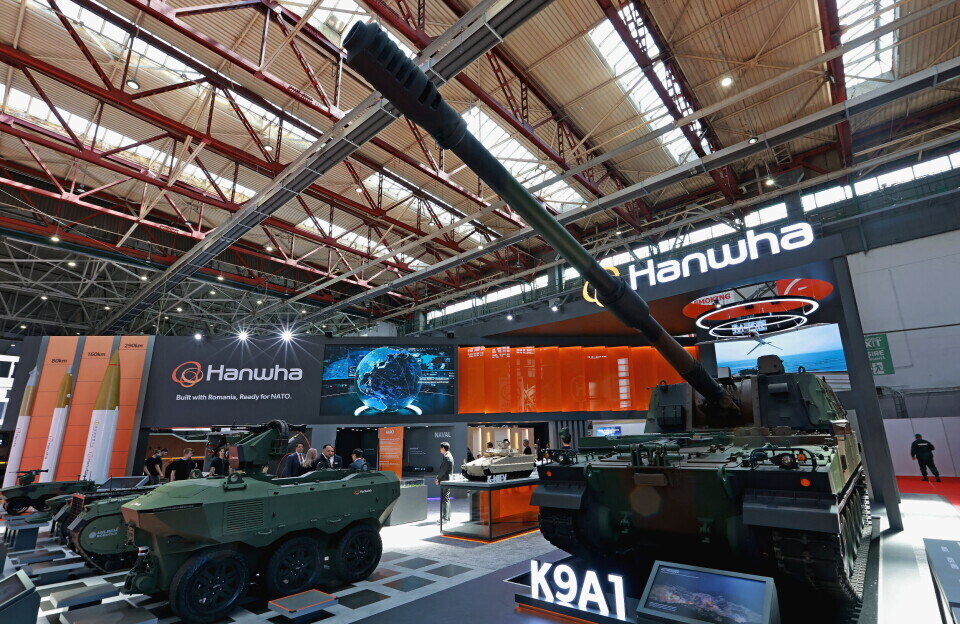
Hanwha Group is rapidly accelerating its expansion into the U.S. defense market, pumping over 1.5 trillion won ($1.1 billion) into its American operations this year. As local business initiatives gain serious momentum—including its first-ever U.S. Navy vessel contract and a prototype supply deal for the U.S. Army's K9 self-propelled howitzer—the conglomerate is deploying massive capital to secure local production hubs and restructure its business framework. Industry analysts interpret this strategy as a direct entry into the U.S. domestic manufacturing and procurement ecosystem, positioning Hanwha as a core player in the local defense supply chain rather than merely relying on weapon exports.
According to industry sources on the 17th, the total capital injected or approved for paid-in capital increases in Hanwha's three primary defense units—Hanwha Aerospace, Hanwha Ocean, and Hanwha Systems—reached approximately 1.506 trillion won this year. Observers note that this annual investment scale could climb even further if additional capital calls are finalized before the year concludes.
Capital Allocation and Strategic Restructuring
Hanwha Aerospace took the lead in financial deployment. The company decided to inject a total of 508 billion won into its U.S. subsidiary, Hanwha Defense USA, through four separate rounds this year: 90 billion won in April, 250.1 billion won across two rounds in July, and 168.4 billion won in September.
The September funding is specifically earmarked to acquire a 60% stake in Philly Shipyard previously held by Hanwha Systems. This move aims to consolidate U.S. maritime and defense operations under Hanwha Defense USA, thereby boosting synergy between business segments and maximizing investment efficiency. Additionally, Hanwha Aerospace committed 280.2 billion won to its U.S. strategic asset investment arm, Hanwha Futureproof, and 220.2 billion won to its U.S. engine parts subsidiary, Hanwha Aerospace USA.
Hanwha Ocean allocated 325 billion won to its U.S. holding company, Hanwha Ocean USA Holdings, through capital increases in February (20.4 billion won), March (164.5 billion won), July (78.4 billion won), and September (61.7 billion won). These funds are projected to drive operations at local subsidiaries, including Philly Shipyard, Hanwha Shipping, and Hanwha Defense & Energy.
Meanwhile, Hanwha Systems contributed a combined 172.1 billion won to Hanwha Systems USA (60.5 billion won) and HS USA Holdings (111.7 billion won).
Ground, Ammunition, and Naval Breakthroughs
Hanwha's heavy investment in its U.S. entities is driven by the necessity to localize production and supply chains to effectively service rising local orders. In the American defense sector, local manufacturing capacity and reliable supply chain security have emerged as critical competitive requirements alongside baseline weapon performance and pricing.
Within ground defense, the company is making visible headway into U.S. Army programs. In August, Hanwha Aerospace secured a prototype supply contract for the K9 wheeled self-propelled howitzer (K9MH) under the Mobile Tactical Cannon (MTC) initiative. Earlier in April, the company leased an idle facility in Opelika, Alabama, for three years to establish a local integration and testing hub for the K9 artillery system.
Ammunition is similarly being cultivated as a mid-to-long-term growth engine. In September, Hanwha hosted an opening ceremony for an office at an Arkansas army ammunition plant, kicking off the establishment of local munitions production infrastructure. Over the next seven years, the firm plans to invest $2.2 billion (approx. 3 trillion won) to build production facilities for 155mm artillery shell components and propellant charges. It also recently established two new U.S. subsidiaries—H Missile Solutions and Hanwha Ordnance Holding—to oversee its expanding ammunition business.
In maritime defense, Hanwha secured a landmark $269 million (approx. 360 billion won) contract last month to build medium landing craft (LSM) for the U.S. Navy and Marine Corps. This marks the company's first major U.S. Navy new-vessel construction contract since its acquisition of Philly Shipyard in 2024.
To further broaden its U.S. shipbuilding and defense portfolio, Hanwha is actively pursuing mergers and acquisitions (M&A). Following a non-binding acquisition proposal submitted in August for Austal USA—a builder of U.S. Navy ships and nuclear-powered submarine modules—Hanwha Defense USA entered into formal commercial negotiations in mid-September.
Furthermore, Hanwha conducted offshore firing tests of its "Chunmoo" multiple rocket launcher system along the southern coast of the U.S. this month. By modifying the land-based system for naval vessel integration, Hanwha aims to break into the U.S. Navy's uncrewed surface vessel market.
Market experts view Hanwha's aggressive U.S. campaign as a strategic play to embed itself deeply within the domestic defense supply chain, transcending short-term contract wins. Given Washington's strong legislative and political emphasis on domestic manufacturing and supply chain self-reliance, corporations possessing localized production plants and shipyards are poised to secure a commanding competitive edge in future defense procurements.
[Copyright (c) Global Economic Times. All Rights Reserved.]