![[등록] 2026-09-01 15:48:31](/support/_updata/banner2/tl181982910_6749.png)


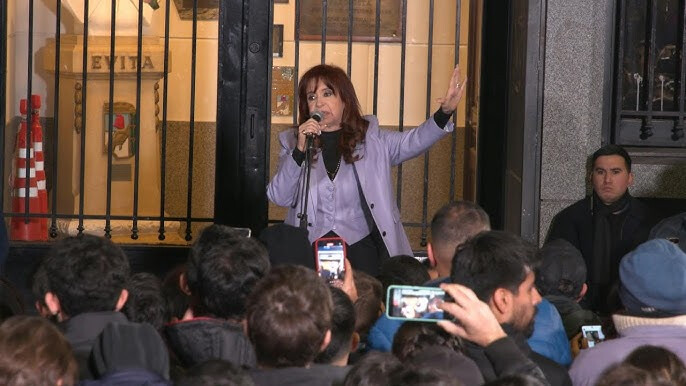
Argentina's political landscape is on the brink of a major storm. Former President Cristina Fernández de Kirchner (72), sentenced to six years in prison and permanent disqualification from holding public office on corruption charges, is scheduled for detention on June 18th (local time). In response, her supporters have announced large-scale protests, escalating pressure on the government and judiciary.
Supreme Court Upholds Verdict, Sparks Peronist Backlash
On June 15th, the Argentine Supreme Court upheld the original verdict against former President Fernández, confirming a six-year prison sentence and permanent disqualification from holding public office. This final ruling pertains to the "road construction corruption" case, in which she was accused of funneling public works projects, particularly road construction, to a specific businessman, Lázaro Báez, and receiving illicit profits in return during her presidential term (2007-2015). Prosecutors previously noted that the profits of Báez's Austral Group surged 460-fold during the Fernández administration, and Báez's personal assets increased 120-fold.
Former President Fernández has consistently maintained her innocence, claiming the trial is a "victimization by the judicial mafia" and a "political persecution" driven by "political motives." Having served as president after her husband, Néstor Kirchner (2003-2007), she has significantly influenced Argentine politics. She is particularly regarded as a key figure in left-wing Peronism, often referred to as 'Kirchnerism.'
Peronism, an influential political ideology in Argentina, inherits the ideas and policies of former President Juan Perón, characterized by strengthened worker rights, nationalization, and expanded welfare. As a symbolic figure of Peronism, Fernández de Kirchner still commands a large base of support among labor unions, civil organizations, and left-leaning groups in Argentina.
'Million-Person Protest' Announced, Heightening Political Tension
According to local media, supporters of former President Fernández plan to march approximately 5 kilometers from her residence to the criminal court on June 18th, the day her detention is scheduled. They have stated that up to one million people will participate in the protest, warning of strong resistance if the court proceeds with the detention.
The protest is being led by Máximo Kirchner, Fernández de Kirchner's son and a current member of the House of Representatives. Máximo Kirchner, a leading figure of the younger generation of 'Kirchnerism,' is inheriting his mother's political legacy while emerging as a prominent figure in Argentina's left-wing politics. With a large number of ordinary citizens angered by the Supreme Court's ruling also expected to participate, the protest is likely to heighten social unrest across the country. The participation of various Peronist parties, including the main opposition Justicialist Party (Partido Justicialista, PJ), the Socialist Party, the General Confederation of Labor (CGT), and various civil organizations, makes the scale and impact of the protest difficult to predict.
Potential for House Arrest and the Judiciary's Dilemma
Some speculate that the judiciary might grant former President Fernández house arrest on June 17th, the day before her scheduled detention, due to concerns about the social repercussions of large-scale protests. The Argentine judicial system operates on a three-tier structure with the Federal Supreme Court at its apex. While the independence of the judiciary is a constitutional principle under the presidential system, there have been persistent criticisms that it is not entirely free from executive influence. If house arrest is granted, it would likely be interpreted as a judicial measure to acknowledge public opposition.
However, supporters plan to proceed with the large-scale march and protest on June 18th regardless of whether house arrest is granted, keeping the government on high alert. Currently, Argentina is experiencing intensified social conflict due to President Javier Milei's libertarian economic reforms and austerity policies. Concerns are growing that the issue of former President Fernández's detention could further accelerate political instability.
The Complexity of Argentine Politics: Peronism vs. Anti-Peronism
This situation once again exposes the enduring complexity of Argentine politics. Argentine politics has long been characterized by a confrontational dynamic between Peronist and anti-Peronist forces. Peronism enjoys a strong popular base, particularly among the working class and marginalized groups. In contrast, conservative and centrist forces criticize Peronism's populist policies and corruption issues, positioning themselves in opposition.
Cristina Fernández de Kirchner is a symbolic figure of Peronism and has been a cornerstone of Argentine politics for nearly two decades, following her husband Néstor Kirchner. Her detention is more than a mere judicial disposition; it is a direct challenge to the Peronist camp and a significant event that could bring about major changes in Argentina's political landscape.
It remains uncertain whether the protests will conclude peacefully or escalate into violent clashes. However, what is clear is that the detention of former President Cristina Fernández will be a crucial turning point with significant implications for Argentina's political and social future. The international community is also closely monitoring the potential ripple effects of Argentina's political instability across Latin America.
[Copyright (c) Global Economic Times. All Rights Reserved.]