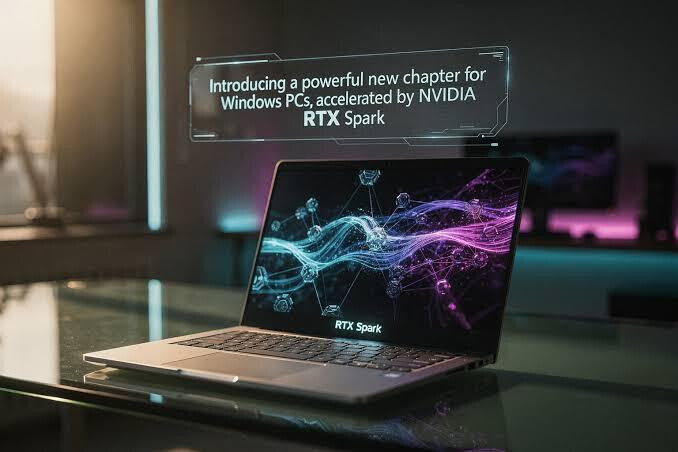
SEOUL — NVIDIA has introduced its cutting-edge "RTX Spark" mobile platform to the South Korean market, promising workstation-grade artificial intelligence capabilities that operate entirely offline, even in remote environments lacking internet access.
During a press briefing held at the JW Marriott Hotel Seoul on Friday, NVIDIA’s APAC Technical Marketing Director, Jeff Yen, highlighted the platform's utility through a personal example. An avid scuba diver, Yen noted that organizing hundreds of raw media files from remote island trips has traditionally been a tedious backlog. With RTX Spark, creators can leverage local AI models to curate, sort, and edit massive visual libraries without relying on cloud servers or stable web connections.
Powered by Blackwell and Grace Architecture
RTX Spark represents a major leap in mobile computing architecture by integrating NVIDIA's next-generation Blackwell Graphics Processing Unit (GPU) and Grace Central Processing Unit (CPU). The platform supports up to 128 gigabytes (GB) of unified memory and delivers up to 1 petaflop of AI computational performance, allowing complex machine-learning models to run natively on the device.
Following its official domestic release on October 16, the platform has been adopted by major manufacturers including ASUS, Dell, HP, Lenovo, Microsoft, and MSI. In South Korea, launch lineups feature flagship models such as the ASUS ProArt P14 and P16, the Lenovo Yoga Pro 9n, and the MSI Prestige N16 Flip AI+.
Pricing reflects the high-end hardware tier: the baseline ASUS ProArt P14 with 24GB of memory starts at approximately 4.699 million KRW, while higher-tier configurations scaling to 64GB and 128GB command roughly 7 million KRW and 9 million KRW, respectively.
Navigating Market Price and Purpose
Addressing concerns regarding the steep price tags, NVIDIA representatives defended the investment by positioning the platform squarely toward professionals.
"While we cannot claim the pricing is inexpensive, the system is engineered for developers and content creators who have anticipated this level of mobile performance," Yen explained, adding that RTX Spark is designed to complement, rather than completely replace, traditional computing setups.
For everyday users focused primarily on gaming, NVIDIA Korea Technical Marketing Managing Director Kim Sun-wook advised sticking to dedicated gaming notebooks, noting that those seeking raw GeForce RTX 5080 gaming metrics should select purpose-built gaming hardware instead.
Cost Efficiency and Data Security
When questioned about whether purchasing an expensive localized workstation is more cost-effective than utilizing cloud AI services, NVIDIA executives emphasized operational flexibility and data privacy.
Running intensive AI workloads—such as robot training algorithms or heavy video production pipelines—in the cloud accumulates continuous subscription fees that can be mitigated through a one-time hardware investment. Furthermore, local processing eliminates security risks by ensuring sensitive data never leaves the physical device.
Regarding potential partnerships with major domestic tech giants Samsung Electronics and LG Electronics—who were notably absent from the initial manufacturer lineup—Yen refrained from confirming upcoming product roadmaps. However, he confirmed that NVIDIA maintains ongoing discussions and supply collaborations with memory giants SK Hynix and Samsung Electronics for component sourcing, though specific supply shares remain confidential.
[Copyright (c) Global Economic Times. All Rights Reserved.]