

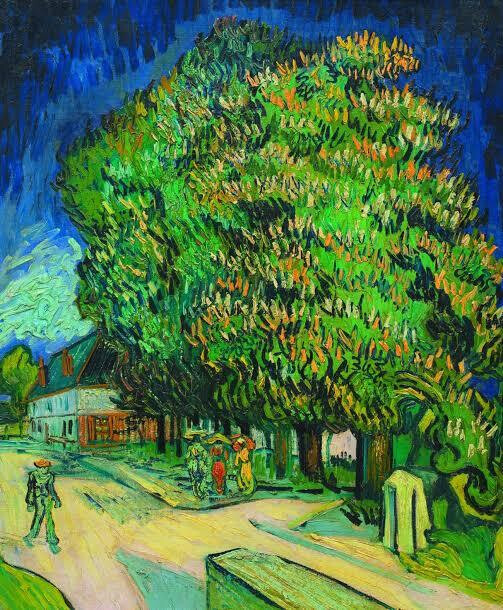
Vincent van Gogh’s Chestnut Blossoms in Flower (Châtaigniers en fleurs)—painted just two months before the artist took his own life—has become embroiled in a high-stakes ownership dispute regarding the legitimacy of a transaction from the Nazi persecution era 90 years ago. Estimated at $180 million (approximately 240 billion KRW), the painting was widely expected to break the record for the highest price ever fetched by a Van Gogh work at auction.
The New York Times reported on the 13th (local time) that descendants of Samuel Fischer, a German-Jewish publisher, have demanded the withdrawal of the auction, claiming the piece was sold under duress due to Nazi regime persecution.
The provenance of the artwork embodies the turbulence of 20th-century European modern history. Purchased by Fischer in 1909, the painting was inherited in 1934 following his death by his daughter Brigitte and son-in-law Gottfried Bermann Fischer. However, as Nazi oppression of Jews intensified, the Fischer family fled Germany into exile. During this process, in June 1936, the painting passed through art dealer Paul Cassirer to a French collector.
Gunnar Schnabel, the legal representative for the heirs, argued, "Without the economic pressure of the Nazis and the special circumstances of exile, the owners would never have voluntarily disposed of the painting," demanding that Sotheby's prove the fairness of the sale price at the time. He also urged consultations based on the "1998 Washington Principles," an international standard recommending the fair resolution of Nazi-looted and confiscated art.
In contrast, Sotheby's has firmly pushed back, asserting that the transaction was a legitimate sale conducted at fair market value. According to art publication ARTnews on the 16th, Sotheby's stated—based on transaction records from art dealer Paul Cassirer—that the work was sold for 68,000 Swiss francs in June 1936.
They argued that given the market price for Van Gogh works at the time, it was by no means a bargain price. Furthermore, Sotheby’s refuted claims of a forced sale by noting that the Netherlands, where the transaction took place, was not under Nazi German occupation at the time, and that the Fischer family had previously made claims for other Nazi-confiscated artworks while never raising issues regarding this specific piece.
A Masterpiece Hidden for Decades
At the center of the dispute, Chestnut Blossoms in Flower holds unique significance in art history. Painted in May 1890 in Auvers-sur-Oise near Paris, shortly after Van Gogh was discharged from the asylum in Saint-Rémy, France, the work features chestnut trees in bloom with white and yellow blossoms, creating an intense contrast against a deep cobalt blue sky that fills the canvas. Critics note that it exemplifies the characteristics of Van Gogh’s most mature period of color mastery.
After entering the collection of prominent Argentine collector couple Carlos Pedro Blaquier and Nelly Arrieta de Blaquier in 1975, the painting remained hidden behind a veil of privacy for nearly 50 years, making it the supreme highlight of the upcoming auction. It had been widely anticipated to easily surpass the previous record for a Van Gogh set by Orchard with Cypresses at a 2022 Christie’s auction (approx. $117.2 million).
[Copyright (c) Global Economic Times. All Rights Reserved.]