![[등록] 2026-09-01 15:48:31](/support/_updata/banner2/tl181982910_6749.png)


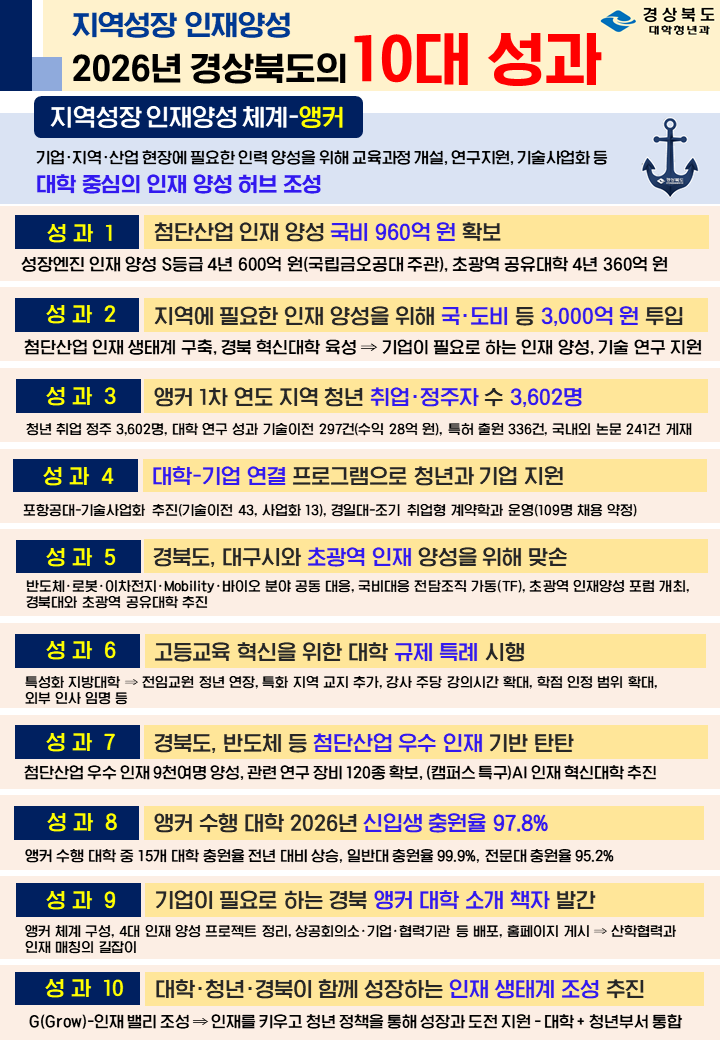
Gyeongsangbuk-do’s regional growth talent cultivation framework, known as the "Anchor Project," is generating significant results by securing national funding, boosting youth employment and settlement, and establishing regulatory exemptions for universities.
The Anchor Project is a university-centered talent cultivation hub that encompasses curriculum development, research support, and technology commercialization to foster the workforce required by businesses and industrial sites.
In 2026, Gyeongsangbuk-do invested a total of 300 billion won—comprising 250 billion won in national funds and 50 billion won in provincial funds—to cultivate necessary local talent and build a system connecting industries with youth settlement.
① Securing 96.0 Billion Won in National Funding for High-Tech Industry Talent
Gyeongsangbuk-do has secured national funds necessary to cultivate high-tech industry talent in the Daegu-Gyeongbuk region, including semiconductors, robotics, and secondary batteries. The province will receive a total of 96.0 billion won, consisting of 60.0 billion won over four years for growth-engine talent cultivation and 36.0 billion won over four years for a super-regional shared university.
In the Growth-Engine Talent Cultivation public competition, Kumoh National Institute of Technology served as the lead university, proposing talent cultivation for semiconductor advanced materials/components and Artificial Intelligence (AI) manufacturing robots, earning the highest "S" grade.
Through this selection, the province can now stably cultivate talent required for the government's three major projects: semiconductors, physical AI, and AI data centers. The province views this as the foundation for resolving labor shortages in local businesses and securing additional national funding related to the three major projects.
② Investing 300 Billion Won Including National Funds for Local Talent Cultivation
Gyeongsangbuk-do injected 300 billion won into 28 anchor universities in 2026 to produce talent required by the Daegu-Gyeongbuk high-tech and strategic industries.
Centered around universities, businesses and research institutes collaborate to nurture talent needed in industrial sites and support necessary corporate technology research. This initiative stems from the judgment that for youths to settle regionally, it is crucial to establish a system that builds capabilities at the university level and fosters talent matching corporate demands.
Moving forward, the province will focus on cultivating talent in four major fields: root/core industries, super-regional strategic industries, future promising industries, and Gyeongsangbuk-do specialized industries. It plans to build a virtuous cycle model where youths learn, work, and settle locally by institutionalizing business-participating curricula, building a high-tech industry talent ecosystem, and fostering the Gyeongbuk Innovation University.
③ Anchor 1st Year Achieves 3,602 Local Youth Employment and Settlement Cases
In the first year of the Anchor Project, Gyeongsangbuk-do achieved 3,602 local youth employment and settlement cases, 297 university research performance technology transfers (worth 2.8 billion won in revenue), 336 patent applications, and 241 papers published in domestic and international citation index journals.
A total of 42,500 people participated in talent cultivation education programs. By acquiring 120 types of joint research equipment for high-tech and strategic industries and operating 202 industry-linked educational courses, the province also expanded its cooperative network with businesses.
The Anchor Project is driving the employment of youth talent in provincial companies, supporting small and medium-sized enterprise (SME) technology commercialization, practical field-oriented university education, and digital transformation. Beyond mere university financial support, the province is pouring efforts into establishing a university-centered innovative talent hub that connects regional industries, education, and settlement.
④ Supporting Youth and Businesses Through University-Business Connection Programs
Gyeongsangbuk-do is discovering and expanding linked support programs so that university technologies and research achievements can be utilized in corporate fields, with businesses using them as growth engines.
POSTECH (Pohang University of Science and Technology) is pursuing technology commercialization by discovering patents, technologies, and ideas from research labs, transferring them to provincial companies, and leading them to startups. Over the past three years, it has transferred 43 technologies to provincial companies, helping small and medium-sized enterprises (SMEs) lacking R&D infrastructure secure core technologies. It also implemented convergence and practical application projects to support 13 cases, some of which have led to commercialization.
Kyungil University operates early-employment contract departments. Upon admission, students secure employment at SMEs without the burden of tuition fees, while companies receive professional talent matching their demands.
Kyungil University is the only four-year university in Daegu-Gyeongbuk operating early-employment contract departments, a system run across seven four-year universities nationwide. It features seven regional specialized fields, including the Defense Industry Systems Department. With an enrollment quota of 200, it is the second-largest scale nationwide while maintaining top-tier freshman enrollment rates.
Among enrolled students, 29.2% come from regions outside Daegu-Gyeongbuk, drawing students nationwide: 7.0% from the Seoul metropolitan area, 12.3% from Busan-Ulsan-Gyeongnam, and 5.7% from the Chungcheong region. Furthermore, 82.9% of graduates are employed by companies in Daegu-Gyeongbuk, leading to regional settlement.
Currently, the university has signed industry-academic agreements with approximately 1,100 companies, with 406 companies committing to hire 106 students in 2025 and 109 in 2026.
⑤ Gyeongsangbuk-do and Daegu City Join Hands for Super-Regional Talent Cultivation
Aligning with the government’s super-regional policy to cultivate talent at the industrial and economic zone level beyond administrative boundaries, Gyeongsangbuk-do is jointly responding with Daegu City in semiconductors, robotics, secondary batteries, and future mobility fields.
Since March 2026, the province has operated a "Super-Regional Talent Cultivation National Funding Response Task Force (TF)" with Daegu City and held a university-centered super-regional talent cultivation forum at the Andong Stanford Hotel. Both local governments are jointly promoting talent cultivation cooperation and discovering/planning projects at the industrial and economic zone level.
Through a partnership with Kyungpook National University, a flagship national university, the province is pushing forward with the super-regional shared university project. It is sharing Kyungpook National University’s curriculum and research equipment with provincial universities while expanding the scope of cooperation through joint educational curricula and joint research.
⑥ Implementation of University Regulatory Exemptions for Higher Education Innovation
To enhance the competitiveness of local universities, Gyeongsangbuk-do has also stepped up to improve regulations that hinder education projects tailored to university characteristics. Regulations requested of the government have been largely reflected.
These exemptions apply to specialized local universities, including: ▵ exceptions to retirement age standards to invite outstanding researchers (relaxing the non-tenure faculty retirement age standard of 65); ▵ additional designation of specialized regional school sites for field-based classes (expanding from Gyeongsan Campus to Yeongdeok and Cheongdo campuses); ▵ expansion of mandatory weekly lecture hours for instructors (from 6 to 9 hours); ▵ expansion of credit recognition limits for cooperative classes (from 1/4 to 1/2 of graduation credits); ▵ permission to appoint external figures to major positions at national universities; and ▵ raising the support ratio for standard field-training semester living expenses.
The province plans to continue regulatory streamlining to lower barriers between departments, universities, industries, and regions, establishing specialized local universities as models for university-region mutual growth.
⑦ Gyeongsangbuk-do Secures Solid Foundation of Excellent Talent in High-Tech Industries Like Semiconductors
Amid expanding high-tech industry investments outside the Seoul metropolitan area, Gyeongsangbuk-do announced that it has successfully established the talent cultivation infrastructure required for attracting businesses.
The province hosts 18 general universities, 13 junior colleges, and 7 cyber/other universities, boasting the highest number of universities outside the metropolitan area. On top of this, it invests 3,000 billion won annually in anchor project funds (1.5 trillion won over 5 years). Last year, it produced about 9,000 high-tech industry talents, solidifying a university-centered cultivation system.
The province is also promoting the Gyeongbuk Strategic Industry Anchor University Project, creating industrial innovation ecosystems centered on specialized universities with the participation of businesses and research institutes to foster core talent in AI, future aviation, and biotechnology.
To build a talent city linked with universities, the province is also pursuing the "AI Talent Innovation University," a campus special zone. This initiative introduces AI systems across university operations overall and creates an AI hub connected to regional industries.
⑧ 2026 Freshman Enrollment Rate Reaches 97.8% for 27 Anchor-Executing Universities
The average freshman enrollment rate for the 2026 academic year across Gyeongsangbuk-do's 27 anchor-executing universities hit 97.8%, up 2.0 percentage points from the previous year. Among them, 15 universities saw their enrollment rates rise compared to last year.
Provincial Universities: 38 schools (18 general universities, 13 junior colleges, 3 polytechnic/functional colleges, 3 cyber universities, 3 graduate universities)
Anchor-Executing: 29 schools (17 general universities, 12 junior colleges) (Excluding 2 schools: Kyungpook National University Sangju Campus and University A [a university subject to restrictions on financial support])
By type, 15 general universities rose 1.0 percentage point to 99.9%, and 12 junior colleges rose 3.3 percentage points to 95.2%.
The province analyzed that this outcome combined the internal innovation of provincial universities and regional-university linkage projects like the Anchor Project, despite conditions of a declining school-age population and concentration in the capital region.
⑨ Publication of "Gyeongbuk Anchor University Guidebook" for Corporate Talent Needs
Gyeongsangbuk-do has published the "Gyeongbuk Anchor University Guidebook," which compiles the strengths, industry-academia cooperation, and specialization capabilities of provincial anchor universities.
The guidebook contains information on 28 anchor (formerly RISE)-executing universities, including 16 general universities and 12 junior colleges. It is organized so that companies can check talent cultivation courses and related departments at a glance.
The front section features a "Gyeongbuk Anchor Map," marking key promotion tasks for each university. It also explains the composition of Gyeongsangbuk-do’s anchor system and its four major talent cultivation projects to help businesses easily grasp the project structure.
University profiles consist of ▵ University Overview (founding year, students, faculty, undergraduate departments, campuses); ▵ Industry-Academia Cooperation Status (technology transfer, joint research, field training, employment/startup linkage, patent performance, and corporate linkage cases); ▵ Department Status (departments by field); and ▵ Equipment Status (list and images of core equipment). This allows readers to compare individual university strengths and contact points for cooperation with businesses and regions.
The province will distribute the guidebook to chambers of commerce, businesses, and regional cooperative organizations, as well as post it on the Gyeongsangbuk-do Anchor Center website. It plans to utilize the material for industry-academia cooperation and talent connection between universities and businesses.
Through this, businesses can quickly find universities equipped with necessary technologies and talent, while universities can expand opportunities to cooperate with the region and businesses.
⑩ Fostering a Talent Ecosystem Where Universities, Youth, and Gyeongbuk Grow Together
Through an organizational reorganization on August 10, Gyeongsangbuk-do integrated the University Policy Division and the Youth Policy Division. By bringing together previously separated university and youth operations, the province is building an ecosystem stretching from talent cultivation to youth settlement.
This reorganization aims to connect and strengthen functions in the university and youth sectors in response to declining school-age populations and youth outflow. Existing teams were expanded from 3 to 6 to reinforce expertise and execution capabilities.
University and youth policies will be re-categorized by target group and reorganized around projects with high youth demand.
In line with the reorganization, the province established the goal of creating "G(GROW)-Talent Valley Gyeongbuk," a talent ecosystem where universities, youth, and Gyeongbuk grow together. It aims to build a model where youth learn, work, and settle in Gyeongbuk.
The core of "G(GROW)-Talent Valley Gyeongbuk" is full-cycle support: cultivating talent via the university anchor system, backing growth and challenges through youth policies, and connecting to regional settlement through K-U City initiatives.
"In the era of Artificial Intelligence, cultivating and securing creative talent is of the utmost importance," said Gyeongsangbuk-do Governor Lee Cheol-woo. "At its core are universities, the cradle of talent cultivation. Hand in hand with local universities and businesses, Gyeongsangbuk-do will build an innovative talent cultivation model that connects local university talent with local businesses, driving regional industrial revitalization and growth."
He emphasized, "Through this, we will foster high-tech industries, attract businesses, make Gyeongbuk the hub of the nation's high-tech industries, and create a virtuous cycle structure in Gyeongbuk where young people return, stay, and work locally."
[Copyright (c) Global Economic Times. All Rights Reserved.]