

Highlighted R&D infrastructure advantages and potential to operate as a solution-testing hub
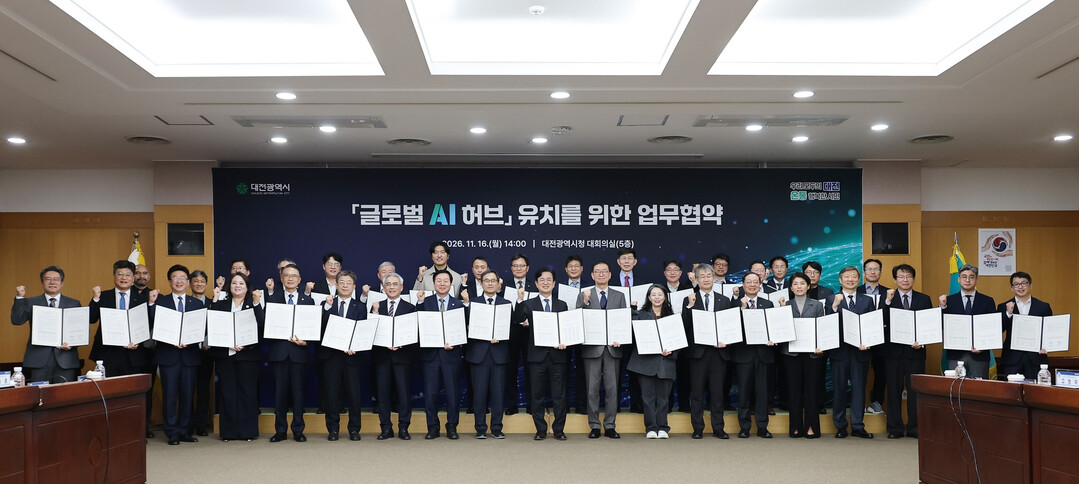
Daejeon City has officially launched its full-fledged efforts to host the “Global AI Hub,” a pan-global artificial intelligence cooperation platform, by joining hands with 35 major local research institutes, universities, and corporations.
The participating entities include the Korea Institute of Toxicology (KIT), National Institute for Mathematical Sciences (NIMS), Asian Society for Innovation and Technology (ASIT), Korea Advanced Institute of Science and Technology (KAIST), Korea Institute of Science and Technology Information (KISTI), Korea Institute of Machinery and Materials (KIMM), Korea Basic Science Institute (KBSI), Korea Research Institute of Bioscience and Biotechnology (KRIBB), Korea Institute of Energy Research (KIER), Electronics and Telecommunications Research Institute (ETRI), Korea Institute of Geoscience and Mineral Resources (KIGAM), Korea Research Institute of Standards and Science (KRISS), Korea Institute of Oriental Medicine (KIOM), Korea Aerospace Research Institute (KARI), Korea Research Institute of Chemical Technology (KRICT), Konyang University, University of Science and Technology (UST), Hanbat National University, Daejeon Institute of Science and Technology, Daejeon University, Daejeon Health Institute of Technology, Mokwon University, Woosong University, Woosong Information College, Chungnam National University, Hannam University, Daejeon Foreign School (TCIS), Daejeon Chamber of Commerce and Industry, Daedeok Industrial Complex Management Corporation, Innopolis Venture Association, SIA Inc., Twomini, Daejeon Science and Technology Promotion Agency (DISTEP), Daejeon Information & Culture Industry Promotion Agency (DICIP), and Daejeon Technopark (TP).
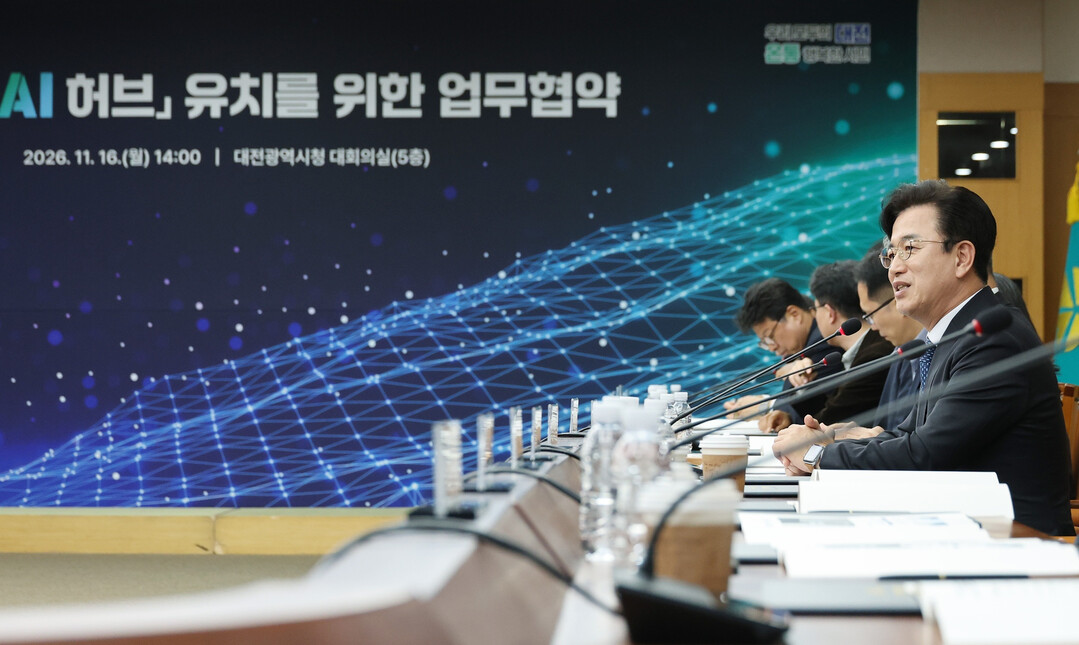
On the 16th, the city held a business agreement ceremony at the Daejeon City Hall Conference Room to secure the bid for the Global AI Hub. Through this agreement, key local research institutions, educational institutions, corporations, organizations, associations, and affiliated agencies participated en masse, uniting their resolve to maximize competitiveness in the bidding process.
The “Global AI Hub” is designed as an international campus where major countries, international organizations, development banks, and industry-academia-research entities collaborate so that all of humanity can share the benefits of artificial intelligence and respond to global challenges. The Ministry of Science and ICT (MSIT) plans to select the site through a public competition.
Daejeon City put forward the unrivaled R&D infrastructure of the Daedeok Innopolis—which has historically driven South Korea’s science and technology—emphasizing that it is the optimal location not merely for providing a physical site and residential environment, but as an “AI solution-testing hub.”
Furthermore, through close cooperation with government-funded research institutes (such as ETRI, KRISS, and KISTI), the city will support the development of AI policies and standards, and provide verification infrastructure alongside businesses to solve global challenges. Simultaneously, in collaboration with universities possessing exceptional global capabilities (such as KAIST, UST, and Chungnam National University), the city plans to support the hub in smoothly executing its core functions by developing and operating educational and training programs and fostering top-tier talent.
Daejeon Mayor Heo Tae-jung stated, "Winning the hub will be a decisive opportunity to connect Daejeon to the center of the global innovation network," adding, "We will leap forward as a global city that creates solutions to the challenges facing the entire world based on artificial intelligence."
[Copyright (c) Global Economic Times. All Rights Reserved.]