• 2026.11.07 (Sat)
  • All articles
  • LOGIN
  • JOIN
Global Economic Times
[등록] 2026-09-01 15:48:31
  • Synthesis
  • World
  • Business
  • Industry
  • ICT
  • Distribution Economy
  • Well+Being
    • Pet Life
    • Halal Horizon
  • Travel
  • Eco-News
  • Education
  • Korean Wave News
  • Opinion
  • Arts&Culture
  • Sports
  • People & Life
    • International Student Report
    • With Ambassador
  • Column
    • Cho Kijo Column
    • Cherry Garden Story
    • Ko Yong-chul Column
    • Kim Seul-Ong Column
    • Lee Yeon-sil Column
  • Photo News
  • New Book Guide
MENU
 
Home > Distribution Economy

Wall Street Suffers Historic Rout as Regulatory Concerns and Leveraged Unwinding Wipe Out $3.2 Trillion

Eugenio Rodolfo Sanabria Reporter / Updated : 2026-11-06 10:33:57
  • -
  • +
  • Print

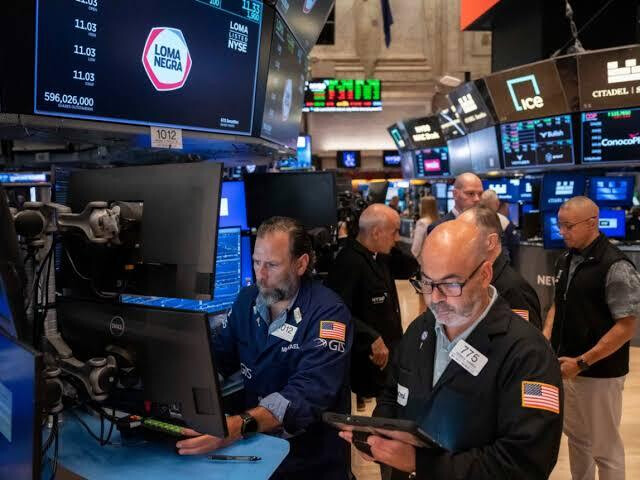
NEW YORK — Financial markets reeled on Thursday following a dramatic shift in the American political landscape. A sweeping victory by the Democratic Party in the U.S. midterm elections sent shockwaves through Wall Street on November 5, erasing an estimated $3.2 trillion in total market capitalization overnight.

The bloodbath was led by high-flying technology equities. The tech-heavy Nasdaq Composite tumbled 5.5% to cross into official correction territory, while the broader S&P 500 retreated 4.4% and the Dow Jones Industrial Average fell 3.4%. All three benchmarks suffered their worst single-session percentage losses since April of the previous year.

Market analysts attribute the massive sell-off to growing anxieties that a newly empowered Democratic legislative majority will enact strict regulatory hurdles on data center expansion and energy consumption. Because Wall Street’s recent multi-trillion-dollar rally has relied heavily on aggressive capital expenditure in artificial intelligence infrastructure—including advanced semiconductors, high-end servers, and power grids—any policy shift threatening this momentum has investors rethinking valuations.

Semiconductors Bear the Brunt

Chipmakers and memory suppliers absorbed the heaviest blows. Nvidia Corp. shares dropped 9.3%, dragging the artificial intelligence bellwether's year-to-date performance into the red. Memory manufacturers faced even steeper drops; Micron Technology plummeted 17%, SanDisk slumped 22%, and Western Digital fell 17%. Telecommunications and hardware giants Qualcomm and Broadcom retreated 9.5% and 10%, respectively. Consequently, the Philadelphia Semiconductor Index logged its most devastating trading session since the onset of the pandemic.

The contagion quickly spilled over into cyclical and non-tech sectors. All eleven primary sectors of the S&P 500 closed in negative territory, with the information technology sector sinking 7.3%. Industrial blue-chips like heavy machinery maker Caterpillar slid 6.4%, while electric vehicle pioneer Tesla and aerospace firm SpaceX each surrendered roughly 10% of their value.

Fear Gauges Spike and Liquidity Dries Up

Panic swept trading desks as the CBOE Volatility Index (VIX) surged 11.57 points—its sharpest single-day upward spike since April of last year. Declining issues outpaced advancers by a factor of roughly six to one on the New York Stock Exchange, while roughly 34.6% of S&P 500 constituents found themselves sitting more than 20% below their 52-week peaks. Notably, customary "dip buyers" were largely nowhere to be found, reflecting a broader institutional rush to secure cash liquidity.

Market strategists suggest that Thursday’s carnage represents more than routine post-election jitters. Instead, it signals a fundamental reassessment of the secular AI growth narrative. If regulatory bottlenecks stall data center construction, downstream corporate earnings across the entire hardware and cloud ecosystem could face severe compression.

Furthermore, technical pressures exacerbated the downward spiral. Financial journalists and market observers noted that the unwinding of leveraged positions and systemic algorithmic stop-losses accelerated the sell-off. For instance, a popular exchange-traded fund offering triple-leveraged exposure to semiconductor indexes cratered 39% during the session.

As Wall Street digests the new political reality, participants warn that market volatility is likely to remain elevated until the policy trajectories regarding technology infrastructure become clearer.

[Copyright (c) Global Economic Times. All Rights Reserved.]

  • #Cherry Garden
  • #HalalFood
  • #Halal
  • #Petlife
  • #Halalhorizone
  • #Hormuz Impasse
  • #globaleconomictimes
  • #micorea
  • #mykor
Eugenio Rodolfo Sanabria Reporter

Popular articles

  • Nearly 900 Schools Temporarily Closed as 'Flu' Epidemic Sweeps Japan

  • AMD CEO Lisa Su Meets with Samsung and SK Hynix Chiefs, Sparking HBM Partnership Hopes

  • AI Companies Rush to Go Public, But Face Sudden Brakes Amid Cooling Investor Sentiment

I like it
Share
  • Facebook
  • X
  • Kakaotalk
  • LINE
  • BAND
  • NAVER
  • https://www.globaleconomictimes.kr/article/1065576782347397 Copy URL copied.
Comments >

Comments 0

Weekly Hot Issue

  • Chungnam Province Expands Agricultural Footprint in Indonesia Through SIAL Interfood 2026
  • Yeosu World Island Fair Concludes 61-Day Run Amid Budget and Management Controversies
  • Hanmi Pharmaceutical and Samsung Securities Team Up to Host Second Bio Innovation Forum
  • NVIDIA Expands Local AI Horizons with RTX Spark Laptops for Offline Creators
  • Portuguese Sweet Legacy Hidden in Thai Desserts
  • Eating 100g of Baechu Kimchi Daily Linked to Lower High-Cholesterol Risks

Most Viewed

1
Why Can't We Use 'Muse' in Korea?… Zuckerberg Says, "Due to a Lack of Data Centers"
2
US Army Conducts Rare Temporary Burial Drills to Prepare for Worst-Case Large-Scale War Scenarios
3
'Goddess of Victory: Nikke' 4th Anniversary Special Broadcast: "Concluding the Ark Story... Preparing for What Lies Beyond the Final Battle"
4
"Germany’s Nuclear Exit Should Serve as a Warning… Let's Solve the Power Crisis in AI & Advanced Industries through SMR Commercialization"
5
Global Credit Spreads Widened to 17-Month High Amid AI Investment Concerns
체리가든 스토리
nutri huevos
로타리
동포저널

Hot Issue

Enjoying Late Autumn's Vibrant Foliage in Daejeon: Where Should We Go?

Beijing Caught Between the Rock of Appreciation and the Hard Place of Growth

Asian Semiconductor Hubs Shaken as Taiwan’s TAIEX Slumps 9% Amid AI Sell-Off

Fashion Runway Show 2026

Let’s recycle the old blankets in Jeju Island’s closet instead of incinerating them.

Global Economic Times
korocamia@naver.com
CEO : LEE YEON-SIL
Publisher : KO YONG-CHUL
Registration number : Seoul, A55681
Registration Date : 2024-10-24
Youth Protection Manager: KO YONG-CHUL
Singapore Headquarters
5A Woodlands Road #11-34 The Tennery. S'677728
Korean Branch
Phone : +82(0)10 4724 5264
#304, 6 Nonhyeon-ro 111-gil, Gangnam-gu, Seoul
Copyright © Global Economic Times All Rights Reserved
  • 향기네무료급식
  • APEC2025
  • 반달곰 프로젝트
Search
Category
  • All articles
  • Synthesis
  • World
  • Business
  • Industry
  • ICT
  • Distribution Economy
  • Well+Being 
    • 전체
    • Pet Life
    • Halal Horizon
  • Travel
  • Eco-News
  • Education
  • Korean Wave News
  • Opinion
  • Arts&Culture
  • Sports
  • People & Life 
    • 전체
    • International Student Report
    • With Ambassador
  • Column 
    • 전체
    • Cho Kijo Column
    • Cherry Garden Story
    • Ko Yong-chul Column
    • Kim Seul-Ong Column
    • Lee Yeon-sil Column
  • Photo News
  • New Book Guide
  • Overseas Koreans
  • Multicultural News