

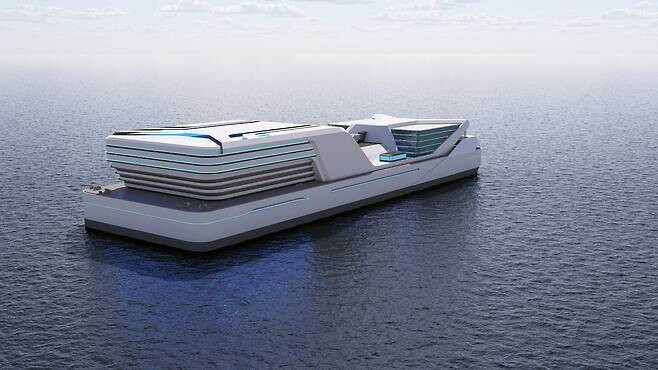
As political and local community opposition to building artificial intelligence (AI) data centers grows, particularly in the United States, companies are seeking solutions in the ocean rather than on land. Investments and production infrastructure to scale up and commercialize "Floating Data Centers" (FDC)—previously operated mainly through small-scale demonstrations—are now accelerating. Major domestic shipbuilders with large-scale offshore plant construction capabilities are also securing design contracts and technical cooperation to preempt this emerging market.
According to foreign media and industry sources on the 16th, American startup Pantalassa opened a marine AI infrastructure production plant on November 6 at the former Kaiser Shipyard site in Vancouver, Washington. Having raised over $300 million (approx. 400 billion KRW) this year, the company is developing an 85-meter-long vertical floating body that generates electricity from wave motion to drive servers. In South Korea, Hanwha Asset Management and NAVER participated as investors. Pantalassa’s data center performs power generation and AI computation simultaneously at sea, with plans to install commercial facilities offshore starting next year.
Another U.S. startup, Atomarine, secured $19 million (approx. 25 billion KRW) in seed funding on November 11. The company plans to build a 75-to-100-megawatt (MW) data center barge and connect it to a separate power barge. Following a demonstration utilizing natural gas power in 2028, the company aims to introduce nuclear power by 2031–2032. In Singapore, infrastructure firm Keppel broke ground on a 25 MW floating data center in the first quarter of this year. The plan is to float the data center off the coast, cool it with seawater, and draw power from the land.
FDCs are evaluated as a viable alternative to land-based data centers, which struggle with site shortages and difficulties in securing power and water. Above all, as demand for AI data centers surges and public opposition to new construction intensifies, FDC investments and project developments are rapidly expanding. According to SK Securities, out of 29 global FDC-related business and technology development announcements, 21 were made this year. This is a more than fourfold increase compared to last year's 5 cases. Furthermore, nearly half of the 10 projects with designated sites and facilities have also commenced this year.
Domestic shipbuilders are actively jumping into the FDC business as well. Experts predict that as facility scales grow, the competitiveness of South Korean shipbuilders—backed by their extensive experience in constructing large offshore plants—will become increasingly prominent.
Samsung Heavy Industries has signed a design contract for two 50 MW FDCs with U.S. data center developer M3, aiming for commercialization by 2028. Leveraging its capabilities in building Floating Liquefied Natural Gas (FLNG) facilities, the company has also filed for approximately 40 FDC-related patents. On the 9th, it signed a joint development agreement with Japanese fuel cell specialist Morimura SOFC Technology. The two companies plan to develop Solid Oxide Fuel Cells (SOFC) applicable to ships and data centers by 2028.
Hanwha Ocean secured conceptual design approval for a 60 MW LNG-powered FDC in September. On the 5th, it signed an agreement with Swiss power and automation technology firm ABB to jointly develop power supply and control technologies by May of next year. The core technology involves adjusting the output of LNG power engines to match the changing power consumption of AI servers and ensuring a stable power supply. SK Securities noted, "As FDC project sizes grow, shipyard newbuilding demand integrating data halls (server installation space), power, and cooling will expand."
[Copyright (c) Global Economic Times. All Rights Reserved.]