![[등록] 2026-09-01 15:48:31](/support/_updata/banner2/tl181982910_6749.png)


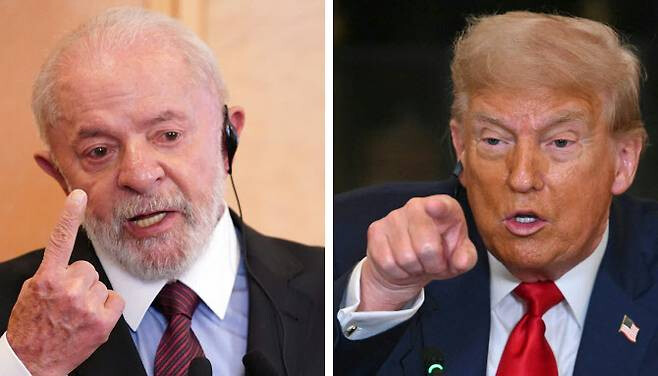
The Brazilian government has strongly warned that if the United States imposes a high tariff of 50% on its exports, it will respond with an equivalent level of retaliatory tariffs, escalating trade tensions between the two countries. Brazilian President Luiz Inácio Lula da Silva declared that while he would prioritize diplomatic solutions to US President Donald Trump's unilateral tariff measures, if negotiations fail, Brazil would immediately respond based on the principle of reciprocity.
On July 10 (local time), President Lula stated in an interview with Brazilian broadcaster RecordTV, "We will try to negotiate first, but if negotiations do not materialize, we will respond based on the principle of reciprocity." He firmly added, "If they impose 50% on us, we will also impose 50%." He then indirectly expressed his dissatisfaction with the US's unilateral measures, saying, "Respect is a good thing. I like to give respect, and I like to receive it."
Trump's 'Interference' Tariffs and Brazil's Strong Rejection The conflict began when President Trump sent a letter to President Lula on July 9, openly announcing a 50% tariff imposition, citing issues with the Brazilian judiciary's indictment of former President Jair Bolsonaro. Trump overtly defended former President Bolsonaro, who is on trial for allegedly plotting a coup to prevent Lula's assumption of power in 2023, calling it a "witch hunt."
In response, the Brazilian government strongly protested, asserting that the US is overtly interfering in its domestic affairs through trade measures like tariffs. President Lula specifically expressed strong dissatisfaction with the situation, claiming, "The former president (Bolsonaro) is sympathetic to Trump's tariff policy on Brazil, and his son, Eduardo Bolsonaro, went to the US and helped persuade Trump." These remarks suggest that the situation could escalate beyond a simple trade dispute to an issue of Brazil's sovereignty and internal interference.
Brazil's 'Trade Retaliation Law' and Policy of Comprehensive Review In April, the Brazilian Congress passed the 'Trade Retaliation Law,' which allows the president to take extensive countermeasures, including tariffs, import restrictions, investmentブロックades, and suspension of intellectual property rights, if a foreign country unilaterally erects trade barriers against Brazilian products. This law was enacted in response to the US imposing a 10% tariff on Brazil in April, but this time President Trump took a stronger stance with a 50% tariff, five times higher.
President Lula stated that he intends to comprehensively review trade policies with the US based on this law. While the Brazilian diplomatic authorities mentioned, "We will not announce official retaliatory measures until the US actually implements the tariffs," and "there is time until August 1," seemingly reserving a final decision, it is interpreted that they are internally preparing a strong response.
Trade Deficit Nation Brazil's Counterattack, Expected Impact on US Economy The United States is Brazil's second-largest trading partner after China, and Brazil exports major agricultural products such as coffee, sugar, beef, and orange juice to the US. Notably, the US is one of the few countries that maintains a trade surplus with Brazil.
Fernando Haddad, Brazil's Finance Minister and a close confidant of President Lula, stated in a Q&A session with reporters broadcast via CNN Brazil and other outlets, "The trade deficit in goods and services with the United States over the past 15 years has exceeded 400 billion reais (approximately 99 trillion won)," adding, "The US tariff imposition cannot be justified." According to Brazilian government data, the cumulative trade deficit with the US from 2009 to June of this year amounts to 90.2 billion dollars (approximately 124 trillion won). Throughout this period, Brazil consistently recorded a deficit with the US. According to the website of the Office of the United States Trade Representative (USTR), trade between the US and Brazil was estimated at 92 billion dollars (approximately 126 trillion won) last year, with the US recording a surplus of 7.4 billion dollars (approximately 10 trillion won).
Impact of Brazil's Counterattack on the US Economy In this situation, if Brazil's 50% retaliatory tariffs materialize, it is projected that the US economy could suffer a greater blow. Brazil's main export products, such as beef, orange juice, and coffee, are items with increasing global demand. Therefore, Brazil can relatively easily find alternative demand sources to replace the US, whereas the US is analyzed to face immediate supply shortages if imports of Brazilian products are virtually halted.
Indeed, according to Reuters, four trade sources warned, "If a 50% tariff is actually imposed, coffee imports from Brazil, the largest coffee importer for the US, will virtually cease." This could lead to higher coffee prices and increased consumer burden in the US.
Brazilian Industry Urges Diplomatic Solutions Brazil's industrial sector is strongly urging the government to pursue diplomatic solutions. José Gomes da Silva, president of the Federation of Industries of the State of São Paulo (FIESP), stated in a press release, "Diplomacy and balanced negotiations should take precedence over ideology and personal inclinations, and we hope that common sense will be restored in relations between the two countries." This is interpreted as a voice of concern about the negative impact of politically driven trade disputes on the real economy.
The current tariff dispute between the United States and Brazil appears to be a test of diplomatic relations between the two countries, going beyond mere trade. As the Trump administration's unilateral trade policies clash with Brazil's determination to uphold its sovereignty, the world's attention is focused on whether the two countries can avoid a breakdown and reach a reasonable agreement. This conflict could significantly impact global supply chains and commodity prices, with relevant industries closely monitoring the situation.
[Copyright (c) Global Economic Times. All Rights Reserved.]